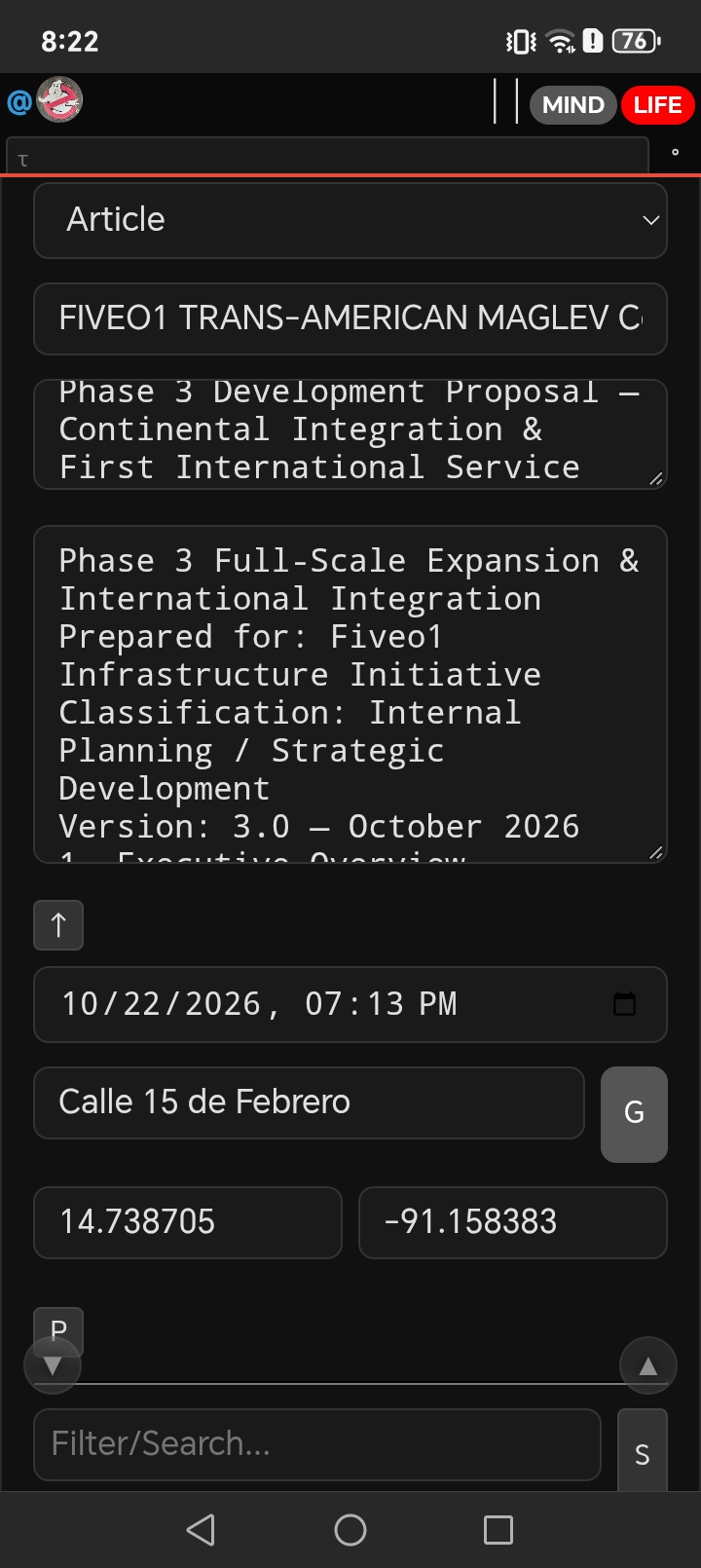
FIVEO1 TRANS-AMERICAN MAGLEV Corridor @2026-10-22 20:13:34 - Calle 15 de Febrero
Calle 15 de Febrero |
Phase 3 Full-Scale Expansion & International Integration
Prepared for: Fiveo1 Infrastructure Initiative
Classification: Internal Planning / Strategic Development
Version: 3.0 — October 2026
1. Executive Overview
Phase 3 is the decisive stage of the Fiveo1 Trans-American Maglev Corridor: the transition from a proven regional high-speed system into a single, continuously operating continental backbone linking the primary economic centers of North America with the first maglev-grade international crossing into Central America.
The proposal is deliberately grounded in the current real-world landscape. The only operating high-speed maglev services today are the Shanghai Transrapid (commercial service since 2002, 268 mph on its airport line) and Japan's superconducting maglev (SCMAGLEV), in advanced testing on the Yamanashi track as part of the Chuo Shinkansen Tokyo–Nagoya–Osaka project. No SCMaglev line is yet in revenue service anywhere in the world — which means the Fiveo1 corridor would enter uncharted territory, and Phase 3 must therefore be engineered, financed, and governed with that first-mover reality priced in: construction benchmarks of roughly $50M–$250M per kilometer, extensive tunneling and elevated guideway requirements, and full incompatibility with conventional rail rights-of-way and terminals.
At the same time, the regional context has never been more favorable. Mexico's President Claudia Sheinbaum has formally proposed extending the 1,477 km Tren Maya network into Belize and Guatemala (~300 km of new line, phases beginning with a 7 km Hondo River crossing), Guatemala's government under President Bernardo Arévalo has created a Presidential Railway Reactivation Committee and is conducting feasibility studies with the U.S. Army Corps of Engineers, and SIECA's Regional Mobility and Logistics Master Plan 2035 targets eleven new rail corridors across all six Central American republics by 2035. Phase 3 positions Fiveo1 to ride — and lead — this wave rather than compete with it.
By the end of Phase 3, the corridor is intended to function as one high-velocity transportation and data spine: continuous domestic trunk service, the first international revenue segment in authorized commercial and dual-use service, and corridor-wide Fiveo1 operational intelligence as the system's nervous system.
2. Factual Baseline & Real-World Precedents (Planning Assumptions)
Every Phase 3 cost, schedule, and risk position is anchored to these verified reference points:
PrecedentStatus (2026)Lesson for
Phase 3
Chuo ShiUnder Budget 30–40%
nkansen construction, contingency on
(Japan, Tokyo–Nagoya; mountainous
SCMaglev)heavily tunneled; southern
multi-year segments;
delays from local front-load
opposition and community
cost escalationconsent
Shanghai In revenue Speed
Maglev (Trservice since advantage
ansrapid)2002; 268 alone does
mph; planned not guarantee
extension selection —
was cancelled Phase 3 must
in favor of win on total
conventional logistics value,
HSRnot just velocity
BaltimorDefunded: FRA U.S. federal
e–Washirescinded ~$26M maglev funding
ngton Sin federal grants is volatile —
CMAGLEV (Aug 2025); Phase 3's U.S.
(USA)environmental segments cannot
approvals depend on
rescindedsustained federal support; diversify the capital stack
Tren Maya 1,477 km in Proven political
(Mexico)operation; will and capital
~$24.8B appetite for
invested; freight mega-rail in the
terminals under exact region
construction Phase 3 targets;
at Cancún, intermodal
Chetumal, terminal
Palenque; model directly
extension transferable
to Belize/Guatemala announced Jan 2025 (~300 km, feasibility pending)
Guatemala Arévalo First-mover
rail reactivadministration institutional
ationprioritizing rail openness in
via Coprefe; Guatemala
USACE feasibility — Phase 3's
studies; FEGUA international
freight system window is now,
dormant since while policy
the 1990s; alignment exists
Mexico pledged 400,000 m of rail materials
SIECA 11 rail corridors Phase 3's Central
Master across American
Plan 2035Guatemala, densification
Honduras, (Sub-Phase
El Salvador, 3D) aligns with
Nicaragua, Costa an existing
Rica, Panama, multinational
targeting framework rather
completion by than inventing
2035one
Maglev co~$50M/km Domestic spine
nstruction (China-grade) completion
cost benchto $250M+/km should target
marks(tunnel-heavy, the low end via
e.g., U.S./Japan serial, modular
terrain)construction; southern extension planned at the mid-to-high end
Planning assumption: dual-guideway mainline averages $75M–$150M per km depending on tunnel share, with the southern extension (Sierra Madre and urban interfaces) at the upper bound. All figures in 2026 USD, to be validated by Sub-Phase 3A engineering.
3. Phase 3 Scope Definition
3.1 Core Expansion Objectives
1. Complete the domestic trunk — close remaining gaps in the Western and Central U.S. spines to deliver continuous inter-regional service at design headway.
2. Deliver the first international crossing — priority sequence: U.S.–Mexico interface at the border region → the Mexico–Guatemala corridor, interoperating with (not duplicating) Tren Maya's planned conventional-rail extension and Guatemala's Pacific-coast reactivation (Tecún Umán–San Marcos ↔ Ciudad Hidalgo–Tapachula).
3. Scale fleet and automated operations — from Phase 2's pilot consists to a mixed passenger/freight fleet at commercial frequency.
4. Deploy full-corridor Fiveo1 systems — energy, data, and predictive operations under Fiveo1 Lattice OS as the single operational control layer.
5. Institutionalize governance — stand up the permanent multinational authority before, not after, the first cross-border revenue service.
3.2 Priority Geographic Focus
- Western & Central U.S. spine completion — serial construction packages to sustain learning-curve cost reduction; target per-km costs converging toward the low end of the benchmark band.
- Southern Extension (Phase 3 flagship): border interface → central Mexico trunk → Guatemala corridor. Alignment to be co-developed with Mexican and Guatemalan rail reactivation programs; interchange terminals at Tren Maya junction points (e.g., Palenque/Chetumal corridors) so maglev premium service and conventional freight expansion are complementary layers of one continental network.
- East–west connectors — selected only where they demonstrably convert existing freight/passenger demand (investment gates in §6).
3.3 Out of Scope (Phase 3)
Belize routing beyond interchange terminals; Panama/Costa Rica maglev spines; any service level dependent on sustained U.S. federal maglev funding (per the Baltimore–Washington precedent, treated as upside, not baseline).
4. Technical & Systems Advancement
4.1 Guideway & Operations
- Full dual-guideway mainline, 4–6 minute headways in high-demand sections; junction-free grade-separated routing throughout.
- Tunnel/elevated share as the dominant cost driver: southern extension expects 25–40% tunneling through the Sierra Madre and urban approaches. Modular guideway segments pre-cast at regional yards (leveraging the domestic-content hubs of §7) to compress schedule and cost.
- Fleet: higher-capacity passenger consists (single 300+ meter trainsets at 500 km/h cruise); specialized freight modules for time-sensitive cargo — perishables, pharmaceuticals, high-value electronics, and authorized dual-use consignments under customs-seal protocols.
- Automation: driverless operation with GoA4, remote oversight from two geographically separated corridor control centers, and AI-assisted disruption management targeting <15 minute recovery from a mainline blockage.
4.2 Fiveo1 Systems Integration (Full Deployment)
- Continuous multi-sensor monitoring — structural health of guideway, environmental sensing (seismic — critical for the southern extension across active fault zones, including areas affected historically by Guatemalan and Chiapan seismicity — plus landslide and flood detection), and perimeter security.
- Real-time geospatial multimedia indexing of all corridor assets, consignments, and surrounding activity, searchable in seconds across the full network.
- Predictive maintenance — corridor-wide AI models targeting ≥40% reduction in unplanned maintenance events versus Phase 2 benchmarks, and dynamic capacity allocation between passenger and freight slots.
- Secure dual-use data layer — auditable, partner-accessible logistics data with strict commercial/governmental separation enforced at the architecture level.
- Energy integration — co-located solar and wind generation plus grid-scale storage at hub sites; regenerative-braking energy recovery feeding corridor storage; grid-interactive operation providing frequency-response services to national grids (a real revenue line, not a cost center).
4.3 Hub & Logistics Evolution
Phase 3 hubs become multi-modal platforms:
- High-speed passenger interchange with conventional rail, Tren Maya connections, and air links.
- Automated freight transfer and consolidation — the Cancún/Chetumal intermodal terminal model (customs facilities, reception tracks, warehousing) is the proven template to replicate at each international hub.
- Energy trading and storage nodes.
- Regional command-and-control for corridor operations and emergency response.
5. Indicative Timeline
Sub-PhFocusTarget Key Gate
aseWindow
3ADomestic spine 2031–20Sustained Phase
completion, fleet 332 operational
scale-up, per-km benchmarks; unit
cost convergencecost ≤ $110M/km rolling average
3BFirst international 2032–20Binding cross-border
segment: 35framework
U.S.–Mexico interface agreements signed;
construction; interoperability
Mexico–Guatemala protocol with Tren
corridor Maya finalized
ground-breaking
3CFull mixed 2034–20Driverless safety
passenger/36case accepted by all
freight service; national regulators
corridor-wide AI systems at full authority
3DCentral American 2033–20Corridor Authority
densification 37treaty ratified;
& governance SIECA Master
formalization Plan alignment
(parallel)agreements executed
Sequencing logic: Sub-Phase 3B deliberately overlaps 3A so that international treaty ratification (the longest lead item) runs in parallel with domestic construction, not after it. The Tren Maya precedent shows cross-border announcements precede feasibility by years — Phase 3 must start the institutional work 24–36 months before any guideway is poured south of the border.
6. Financing & Institutional Structure
6.1 Capital Stack
Phase 3 shifts from grant-dependent to mature, multi-source funding — a structural necessity given the August 2025 federal rescission of the Baltimore–Washington SCMAGLEV grants, which demonstrated that U.S. federal maglev support cannot be a baseline assumption:
1. Long-term revenue bonds backed by corridor cash flows (primary layer, ~35–45% of Phase 3 capital).
2. Public–private partnerships and concessions — Mexican and Central American segments under availability-payment or hybrid concession models.
3. Strategic and dual-use funding streams — defense/logistics modernization budgets, justified by the corridor's authorized dual-use capability.
4. Cross-border development finance — IDB, CAF, and bilateral export-credit agencies (Japanese and European ECAs have direct SCMaglev supply-chain interests).
5. Value capture — station-area joint development and energy co-location revenues.
6.2 Institutional Architecture
- Trans-American Maglev Corridor Authority (TAMCA) — a permanent multinational entity with treaty basis, modeled on precedent cross-border rail governance, with authority over standards, safety, customs-seal protocols, and expansion approval.
- National operating subsidiaries in each jurisdiction, each certified by its national regulator, operating under common TAMCA technical standards.
- Fiveo1 systems role formalized by contract, not by default: Lattice OS as the designated operational technology provider with regulator-audited security architecture.
7. Key Risks & Mitigations
RiskSeveriMitigation
ty
Cross-border CriticEarly binding
political & alframework treaties;
regulatory risk — staged technical
administrations pilots per segment;
change; the Balticapital stack
more–Washington that functions
cancellation shows without any single
even mature government's
projects can lose ongoing
federal support appropriation
overnight
Cost escalation in HighModular serial
southern terrain construction;
— Sierra Madre 30–40%
tunneling; Chuo contingency
Shinkansen-style on Sub-Phase
delay spiral is the 3B; investment
failure modegates tied to demonstrated per-km cost from 3A
Interoperability HighAlignments
& community co-developed
opposition — with Tren Maya
maglev cannot and Guatemalan
use conventional reactivation
rail terminals or programs;
rights-of-way; the early, funded
Baltimore project's community-benefit
neighborhood agreements;
opposition and interchange-first
NEPA difficulties design
are the cautionary case
Cyber & physical HighDefense-in-depth
security of a with
continental Fiveo1-controlled
automated systemmonitoring layers; independent red-team certification per jurisdiction; segregated dual-use data layer
Seismic exposure HighMaglev's
of southern monitored,
extension (Chiapascontinuous-sensor
–Guatemala fault guideway is
systems)an asset here: structural health monitoring designed to seismic early-warning standards; redundancy in tunnel ventilation and evacuation systems
Technology-MediuPhase 3's business
selection risk mcase rests on
— Shanghai's total logistics
cancelled maglev value (freight
extension shows velocity, dual-use,
conventional data spine),
HSR can displace not passenger
maglev on speed alone;
cost-effectivenessconventional-HSR interchange is a feature, not a threat
Workforce & MediuDomestic content
supply-chain scalemrequirements; regional guideway manufacturing hubs at hub cities; certified-training academies per jurisdiction
8. Phase 3 Success Criteria
Operational
- Continuous high-speed service across the completed domestic trunk at design headway, ≥99% schedule reliability over 12 consecutive months.
- First international revenue segment in commercial and authorized dual-use service.
Financial
- Per-km construction cost within the §2 benchmark band, converging toward the low end through serial learning.
- Positive corridor-level operating cash flow (EBITDA) by end of Sub-Phase 3C.
Systems
- Corridor-wide Fiveo1 Lattice OS at full operational authority: ≥40% unplanned-maintenance reduction, measurable freight-velocity and mode-shift gains versus Phase 2 baseline.
Institutional
- TAMCA treaty ratified by all participating states before first cross-border revenue service.
- Formal interoperability and alignment agreements with Tren Maya, Guatemala's Coprefe program, and SIECA's Master Plan 2035.
Economic impact
- Demonstrated passenger mode shift from air and highway on served corridors; documented regional development uplift at hub catchments (to be measured against pre-Phase 3 baseline data captured in 2027–2028).
9. Immediate Next Actions (Phase 3 Preparation, Q4 2026 – Q4 2028)
1. Benchmark capture — complete Phase 2 performance and unit-cost benchmarks to fix the 3A cost model and gate thresholds.
2. Cross-border working groups — initiate formal technical/regulatory working groups with Mexican (Sedena/Andrés dossier permitting), Guatemalan (Coprefe, with USACE feasibility alignment), and SIECA counterparts within 6 months; target a memorandum of interoperability with Tren Maya by end-2027.
3. Alignment & environmental studies — advance detailed alignment, seismic hazard, and environmental studies for the southern extension; co-scope with Guatemala's ongoing USACE feasibility work to share data and cost.
4. Financing structuring — issue the first Phase 3 revenue-bond program; secure ECA and development-finance commitments before breaking ground on 3B; design the stack to survive any single government's funding withdrawal.
5. Supply chain — expand supplier and construction capacity agreements; site the first regional guideway manufacturing hub; launch the certified-workforce academy.
6. Governance drafting — begin treaty drafting for TAMCA in parallel with all of the above; institutional lead time is the critical path for international service.
10. Closing Position
Phase 3 converts the Fiveo1 corridor from a high-performance regional system into a true continental infrastructure backbone — and it does so at a genuine inflection point in the region's rail history. Mexico is building cross-border rail for the first time in decades, Guatemala has its first serious railway reactivation program in a generation, and Central America has a published multinational rail master plan targeting 2035. At the same time, the collapse of U.S. federal support for the Baltimore–Washington SCMAGLEV is a sober reminder that maglev programs survive only when their funding is diversified, their institutional foundations are treaty-deep, and their value case extends far beyond speed.
Phase 3 is engineered to all three conditions. Executed on this basis, the corridor becomes what no rail system in the Americas has yet been: a continuously operating, AI-coordinated, multi-jurisdiction spine moving people, priority freight, and energy intelligence across a continent — under Fiveo1 operational intelligence.
Appendix A — Reference Sources
- Maglev cost benchmarks ($50M–$250M/km): Trainspottr analysis; Ken Research, Global Maglev Market
- U.S. Congressional Research Service, Maglev Trains: Technical Background, Cost Estimates, and Recent Developments: CRS IF11834
- Baltimore–Washington SCMAGLEV federal defunding (Aug 2025): Railway Pro; Maryland Matters
- Tren Maya extension to Belize/Guatemala (~300 km, phased; freight terminal program): Railway Gazette International; Mexico News Daily
- Guatemala railway reactivation (Coprefe, USACE feasibility, Tecún Umán–Tapachula link): Prensa Libre
- Tren Maya scale (~$24.8B, 1,477 km) and Guatemala rail history (FEGUA, Northern Railroad 1896–1968): Mexico Travel Secrets
- SIECA Regional Mobility and Logistics Master Plan 2035 (11 corridors, six republics): Mexico News Daily
This document is a strategic planning proposal for the Fiveo1 Infrastructure Initiative. Real-world figures are cited as planning benchmarks as of October 2026 and must be validated by Phase 3 engineering and market studies. ← All Articles← Home