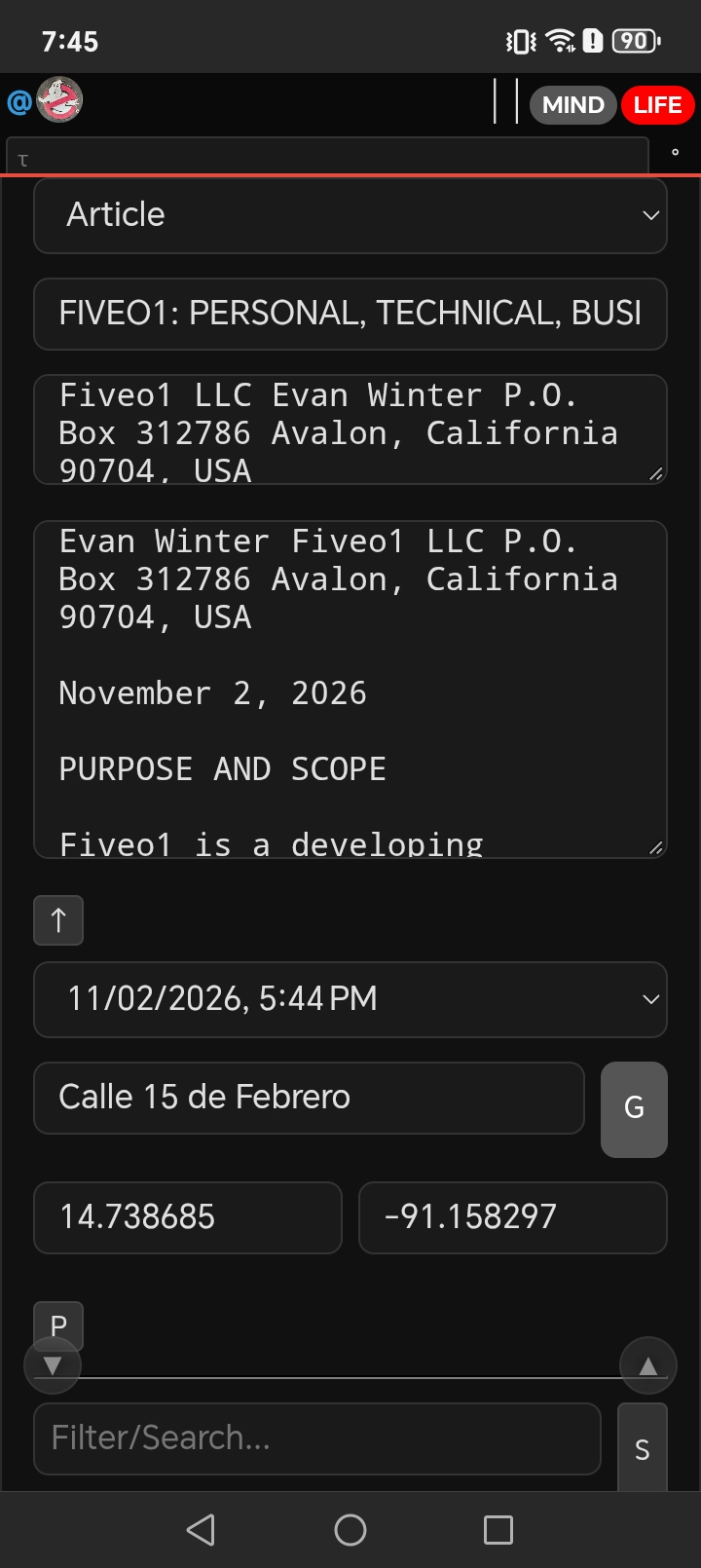
FIVEO1: PERSONAL, TECHNICAL, BUSINESS AND INFRASTRUCTURE Framework @2026-11-02 19:44:19 - Calle 15 de Febrero
Calle 15 de Febrero |
Evan Winter Fiveo1 LLC P.O. Box 312786 Avalon, California 90704, USA
November 2, 2026
PURPOSE AND SCOPE
Fiveo1 is a developing business and technology framework encompassing software engineering, geospatial information, multimedia documentation, resilient computing, infrastructure development, materials engineering, transportation concepts, international business research and technical analysis.
The common operating principle is the design of systems that collect information, organize it into usable structures, maintain continuity during failure, and support decisions through verifiable records. The same principles apply to a software platform, a distributed computing network, an engineered vehicle, a building envelope, a pressure vessel or an international operating structure.
The material in this document brings together the personal background, technical interests, business concepts, engineering proposals, travel experiences and research supplied for Fiveo1. It distinguishes established facts from personal accounts, proposed designs, preliminary estimates and concepts that still require engineering, legal or commercial verification.
PERSONAL BACKGROUND AND TECHNICAL DEVELOPMENT
Evan Winter was born November 13, 1979. His education and technical development followed a largely self-directed path. He graduated from high school and attended community college intermittently for approximately three years. He did not earn a college degree. Sociology and physical education were the only subjects he recalls passing during that period.
His interest in computers began around age twelve, when he used an AOL dial-up connection and participated in online chatrooms. At approximately twenty-one, he began experimenting with software applications, including Photoshop, Illustrator, InDesign and Dreamweaver. By watching the code panel in Dreamweaver change as he moved objects and modified page layouts, he began learning the relationship between visual interfaces, HTML, CSS and JavaScript.
He subsequently experimented with Linux and Kali Linux, learning through practical use, troubleshooting, reverse engineering and independent research rather than a formal computer science program. His technical experience developed through examining software behavior, file structures, URLs, directories, application interfaces and the relationship between browser-side and server-side operations.
His stated technical experience includes PHP, JavaScript, HTML, CSS, Bash, Linux, Git, Apache, MySQL, SQLite, web development, application troubleshooting, web scraping, network analysis and penetration-testing tools. These are self-described areas of practical experience, not a claim of professional certification or independently verified mastery of every tool.
His employment history includes work in newspaper delivery, septic services, automotive tire and lubrication services, disability-support camping, freight and dock operations, sales, cemetery services, mortuary and human-remains transportation, telemarketing, office management, medical-office administration, construction, marketing, technology consulting and application development.
At Xerox Image Source, he worked in telemarketing, supplies account management, application programming, intranet development and related software projects. He reports receiving recognition for application development. He also operated New Start Technology, providing information-technology consulting to approximately thirty-five clients before liquidating the business and leaving for Thailand.
He describes his employment history as a series of positions he voluntarily left rather than positions from which he was dismissed. He reports that he stopped conventional employment around 2017 and subsequently concentrated on travel, personal projects and independent technical work.
His volunteer activities included approximately ten years with Youth Hope, approximately fifteen years with Hands of Mercy assisting with small-home construction in Baja California, approximately six years with Kiwanis and approximately fifteen years with Foster Family Network. These periods overlapped and should not be added together as consecutive years.
His experience includes travel through the United States, Thailand, Vietnam, Cambodia, Malaysia, Indonesia, Sri Lanka, the United Arab Emirates, Egypt, Israel, Hungary, Romania, Bulgaria, Turkey, Greece, Albania, Montenegro, Bosnia and Herzegovina, Croatia, Slovenia, Italy, France, Spain, Portugal, Morocco, Mexico, Guatemala, Colombia, Venezuela, Panama, Costa Rica, Nicaragua, Argentina and Chile.
His travel and international experience have involved different languages, border procedures, transportation systems, living conditions and local economies. These experiences inform his interest in geographically distributed systems, international operations and the practical requirements of operating across different jurisdictions.
PERSONAL LEGAL HISTORY AND DISCLOSURE
The following account is provided as Evan Winter's own description of his legal history and is not an independently verified court record.
He reports that on July 4, 2021, he took a Mercedes-AMG C63 S from a closed dealership in Medellín, Colombia, using a concrete block to gain access. During the subsequent incident, he disarmed a police officer of a .38-caliber revolver, removed its ammunition and returned the firearm. He was arrested and later pleaded guilty to grand theft auto. He reports receiving a seven-year sentence and serving approximately four years and eight months.
He reports being held initially in police detention facilities in Envigado, including cells numbered three and two, before being transferred to Bella Vista prison. He states that he was released on March 18, 2026.
He further reports that after his release he traveled into Venezuela, where he was detained by security personnel identified as SEBIN and DGCIM, and that the United States Embassy subsequently assisted him with an emergency passport. The details of these events, including the precise legal status and official records, require verification before use in a formal legal or employment disclosure.
Any employment, licensing, immigration, financial or government application must answer the questions actually asked and comply with the applicable disclosure rules. A foreign conviction should not be represented as nonexistent merely because a domestic background search may not display it.
The following information is treated as confidential administrative data and is not reproduced as public information: Social Security number, government registration numbers, tax records, EINs, personal residential addresses and other identity credentials. The business identity supplied for this document is Evan Winter, Fiveo1 LLC, P.O. Box 312786, Avalon, California 90704.
FIVEO1 BUSINESS AND OPERATING STRUCTURE
Fiveo1 LLC is the business identity supplied for the proposed activities. The mailing address is P.O. Box 312786, Avalon, California 90704.
The Fiveo1 framework includes several related but distinct areas of work:
* Software development and digital infrastructure.
* Geospatial, photographic and video documentation.
* Chronological journey mapping and searchable records.
* Distributed hosting, virtual machines and application recovery.
* Regulatory and commercial intelligence.
* International infrastructure and investment research.
* Biomimetic materials and structural engineering concepts.
* Transportation and amphibious vehicle development.
* Semiconductor manufacturing and computing technology research.
These activities may share technical infrastructure, data-management principles and business administration. They should nevertheless be maintained as separately accounted projects, with distinct operating requirements, liability controls, budgets and regulatory obligations.
FIVEO1 POT9 AND THE SOVEREIGN INTELLIGENCE PLATFORM
The Fiveo1 POT9 concept is a browser-based multimedia capture and information-management platform. Its purpose is to document photographs, videos, geographic coordinates, timestamps, descriptions and associated records in a chronological and searchable structure.
The broader Sovereign Intelligence Platform extends this concept into a self-hosted application for geospatial multimedia capture, analysis, chronological journey mapping and structured information retrieval.
The proposed system uses a conventional web stack consisting of PHP, SQLite, HTML, CSS and JavaScript. It is intended to operate on standard Linux-based hosting environments using Apache or NGINX, with optional FFmpeg integration for video processing and thumbnail generation.
The platform is designed around several core functions.
A user opens the application through a browser. After receiving the necessary permissions, the browser can access the device camera, microphone when specifically required, and geolocation services. The user can capture photographs or video, enter descriptions and submit the material to the server.
The server validates the submission, stores the media file and records its associated information in a database. The resulting record can include a title, description, file name, file location, latitude, longitude, location name, creation time and other permitted metadata.
A simplified database structure may include:
id content_type title description content filename file_path thumbnail latitude longitude location_name created_at client_capture_time server_received_time ip_address session_identifier
The database should distinguish the time reported by the client device from the time the server receives the submission. Client-side timestamps can be modified, and device clocks can be inaccurate. A server-generated receipt timestamp provides a separate reference but does not independently prove that the original media is authentic or unaltered.
The application can display a chronological feed, individual article records, photographs, videos, location information and map-based journeys. A query such as an article identifier can open an individual record. Search and filtering can organize information by date, location, content type and descriptive text.
The proposed platform also includes chunked video uploading. Large files can be divided into smaller fragments, transferred separately and reassembled by the server. A five-megabyte fragment size is one possible configuration, not a universal requirement. Chunking does not eliminate server limits on total upload size, execution time, storage capacity or network resources. The implementation requires upload identifiers, fragment ordering, integrity checks, file-size limits, authorization, timeout handling and cleanup of incomplete uploads.
The platform's geospatial function can calculate straight-line distances between successive recorded coordinates using the Haversine formula. Such calculations represent distances between coordinate points, not the actual road, trail, flight or water route traveled. GPS errors, missing records and large time gaps can produce misleading results. The interface must identify calculated distances as coordinate-based estimates rather than verified travel distances.
A Leaflet-based map can display location markers and connect chronologically ordered points. The application may limit the number of displayed points to preserve browser performance. A limit of 500 or 1,000 visible points is a configurable presentation choice, not a limit on the total records stored.
The platform can use JSON-LD structured data to describe public photographic collections and individual content records. Public pages can expose appropriate metadata to search engines while protecting private records and personal information.
The POT9 concept also includes a simplified camera-capture model intended to take photographs at approximately one-second intervals. One image per second is a target capture interval, not a guaranteed operating rate. Browser scheduling, device temperature, battery state, network interruptions, camera permissions and operating-system restrictions can interrupt or slow capture. Mobile browsers may suspend background activity, and camera access requires an appropriate secure context and user permission. The application must not imply that it can reliably record while a device is locked or the browser is suspended.
Geolocation should be refreshed according to the intended journey-recording accuracy. Obtaining a location only once per session can produce incorrect coordinates when the user moves. Periodic location updates, accuracy measurements and timestamps should be recorded where the user has consented to location collection.
Reverse geocoding may use a service such as Nominatim to translate coordinates into a readable location. Such services require compliance with their published usage policies, including appropriate identification, caching and request-rate limits.
IP-address collection must be configured carefully. Forwarding headers such as X-Forwarded-For should only be trusted when they originate from known and configured proxy servers. Otherwise, a client can submit misleading values. IP addresses and precise location records can constitute personal information and require appropriate protection.
A browser-generated session identifier stored in sessionStorage is not a reliable browser fingerprint. It can be deleted, changed or reset, and its persistence is limited by the browser's session behavior. It should be described as a session identifier rather than a permanent identity or proof of attribution.
The system's security architecture should include authenticated access, role-based permissions, encrypted connections, protected file storage, input validation, upload restrictions, rate limiting, database backups, logging and tested recovery procedures. A public upload endpoint without authentication or abuse controls is not suitable for an unrestricted production deployment.
The platform can preserve evidence and support an audit process, but it cannot independently establish a legally defensible chain of custody. Stronger evidence management requires controlled identities, access records, cryptographic file hashes, signed audit events, secure timestamps, retention policies and independent verification.
A hash can demonstrate that a file matches a previously recorded version. It does not establish that the original photograph or video depicts what its creator claims. GPS coordinates, device timestamps, IP addresses and session identifiers can all be manipulated or misattributed.
The proposed codebase is intended to remain lightweight and compatible with ordinary PHP hosting. Claims regarding exact source-code size, processing speed, database performance and storage capacity require measurement on a specified hardware and software configuration.
For example, if each image averages 80 kilobytes and the system captures one image per second, the theoretical storage requirement before database and filesystem overhead is:
80 KB per image 4,800 KB per minute 288 MB per hour 6.912 GB per 24-hour day Approximately 207.36 GB per 30-day month
These figures demonstrate why storage quotas, retention rules, compression and user-controlled capture intervals are necessary.
The platform may use SQLite for modest deployments. Larger concurrent workloads may require a different database architecture, depending on write frequency, indexing, query complexity and the number of simultaneous users.
The proposed application should be tested against the PHP versions actually supported by the hosting provider. PHP 7.4 and later should not be treated as equally supported or secure simply because the source code is compatible with older syntax. Deployment should use a currently supported PHP release and maintain a documented upgrade process.
The proposed public repository name is fiveo1/pot9. A repository, MIT license or production-readiness claim should only be represented as established after the corresponding repository, license text, source code and test records have actually been published or verified. The MIT License requires retention of its copyright and permission notice in copies or substantial portions of the software.
FIVEO1 LEÓN–HUNTINGTON BEACH OPERATIONAL MODEL
The proposed Fiveo1 POT9 operating structure identifies León, Nicaragua, as a potential international operational base and Huntington Beach, California, as a potential software and data-analysis location.
The intended division of responsibilities is:
León, Nicaragua: Business administration, property ownership where legally permitted, local technology operations, general logistics planning and international business coordination.
Huntington Beach, California: Software development, data analytics, application maintenance, compliance software and technical administration, subject to applicable city, county, state and federal law.
The two locations would operate as separate legal and administrative environments. A business presence in one jurisdiction does not automatically authorize the same activity in another.
NICARAGUA FOREIGN INVESTMENT AND SPECIAL ECONOMIC ZONES
Nicaragua's Law No. 1240, the Foreign Investment Law, was approved on February 20, 2025, and published in La Gaceta on February 24, 2025. Its implementing regulation was approved on June 3, 2025, and published on June 4, 2025. The Ministry of Development, Industry and Commerce, MIFIC, identifies the law and its regulation as part of the current foreign-investment framework. mific.gob.ni +2
Law No. 1264, the Law on Special Economic Zones of the Belt and Road, was published on October 31, 2025. It establishes a special economic-zone framework covering specified activities, including manufacturing, agroindustry, technology and value-added services that facilitate international trade. The law provides for applicable fiscal, customs, port, border and administrative incentives. Its implementing regulation was issued in December 2025. vLex Nicaragua +2
The existence of these laws does not automatically establish that a particular property, company or activity qualifies for an investment incentive. Eligibility, registration, approval, permitted activities, operating conditions, tax treatment and reporting obligations must be confirmed with the relevant Nicaraguan authorities and qualified local counsel.
The proposed minimum investment of USD 50,000 and the precise registration requirements should not be treated as universal requirements without confirmation against the applicable law, regulation and investment category.
The proposed León location should be evaluated according to title, ownership restrictions, zoning, coastal setbacks, access, utilities, drainage, flood exposure, erosion, insurance, environmental requirements, property taxes and the enforceability of contractual rights.
The preliminary property figures supplied for León, including approximately USD 30,000 for small bungalows and approximately USD 7 per square foot for beachfront plots, are market estimates rather than verified valuations. Each property requires independent title review, physical inspection, boundary verification and comparable-sales analysis.
CANNABIS REGULATORY SEPARATION
The supplied cannabis-related business concept must be separated from Fiveo1's general software and infrastructure activities.
Nicaragua's controlled-substances legislation restricts activities involving cannabis cultivation, production, possession and related trade, subject to the specific authorizations provided by law. The supplied statutory text identifies cannabis cultivation and related activities as prohibited unless expressly authorized by the Ministry of Health. The existence of a foreign-investment law or special economic zone does not create an automatic cannabis authorization. Justia +1
Accordingly, the León operating concept must not include cannabis cultivation, processing, storage, packaging, distribution, import, export or physical handling unless a specific lawful authorization is confirmed by competent Nicaraguan authorities. A proposed software-only operation does not remove the need to assess whether its actual services, data, contracts, customers or financial transactions create regulatory exposure.
In California, state cannabis authorization and local land-use permission are separate requirements. The California Department of Cannabis Control's February 2026 local-law information identifies Huntington Beach as prohibiting the listed categories of cannabis business activity. The city's zoning provisions expressly prohibit medical marijuana businesses and related distribution operations. Department of Cannabis Control +2
A software company must still comply with ordinary business licensing, zoning, privacy, consumer protection, data security and other applicable laws. Describing a business as software-only does not itself establish that the business is exempt from all cannabis-related regulation.
The proposed business model therefore treats the platform as a general-purpose software and data-analysis system. Any work for a regulated industry requires legal review of the actual services, customer relationships, data flows, payments and contractual responsibilities.
The proposed No Rat's Allowed policy is an internal governance and security standard. It is intended to prevent unauthorized access, fraud, conflicts of interest, regulatory violations and misuse of company information. The phrase is a policy name, not a legal classification.
Its proposed controls include identity verification, background checks where lawful, reference checks, financial and conflict-of-interest reviews, multifactor authentication, role-based access, audit logs, independent compliance reviews and documented partner approval.
Biometric access controls require particular care because biometric identifiers are sensitive information. Collection should be limited to a legitimate security purpose, supported by appropriate consent and legal authority, protected against unauthorized access and subject to retention limits.
A proposed smart contract called NoRat.sol could encode selected contractual procedures, approval requirements or payment conditions. A smart contract cannot independently determine whether a person has committed misconduct or whether a legal violation has occurred. Human review, reliable source data, dispute procedures, legal agreements and authorized decision-makers remain necessary.
Blockchain records can preserve transaction history, but they cannot guarantee the accuracy of information entered into the system. Supply-chain tracking must be supported by reliable source documentation, authorized participants and independent audits.
Customer information should be minimized. Hashing an identity does not necessarily anonymize it, especially when other information can be used to reconnect the record to an individual. Shipping addresses and identity records require access controls, encryption, documented retention and lawful deletion procedures.
Multi-signature payment arrangements may reduce the risk of unilateral fund release. They do not eliminate counterparty risk, fraud, legal disputes, insolvency or regulatory obligations.
The proposed León and Huntington Beach model is therefore a general technology and business structure. Any regulated-industry work must remain within the law of the jurisdiction where each activity occurs.
DISTRIBUTED COMPUTING AND HIGH-AVAILABILITY INFRASTRUCTURE
The Fiveo1 infrastructure proposal uses multiple virtual machines connected through a hub-and-spoke network. The purpose is to separate applications, services and operational functions while preserving the ability to recover from hardware, software or application failure.
The preliminary configuration proposes virtual machines with approximately 20 GB of disk capacity, 2–4 GB of memory and one or two virtual CPUs. These are initial resource allocations, not universal production specifications. Actual requirements depend on the operating system, application workload, database size, network traffic and storage behavior.
VirtualBox may be used for development and testing. Proxmox VE, Hyper-V or another supported virtualization platform may be used for production, depending on hardware, licensing, operational expertise and recovery requirements.
A production deployment should distinguish between:
Development environments. Application servers. Database services. Media-storage services. Monitoring and logging. Backup systems. Network gateways. Recovery infrastructure.
A virtual machine does not receive an independent public IP address merely because it is connected to a host-only network. Host-only networking creates a private network between the host and virtual machines. External access requires an appropriately configured bridge, router, NAT gateway, firewall or public-address allocation.
Individual public IP addresses should only be assigned where the hosting provider, network architecture and security design support them. Public exposure of every virtual machine is not necessary for a hub-and-spoke model and can increase the attack surface.
THE DAILY CLONE AND RECOVERY MODEL
The proposed auto-empty file strategy is more accurately described as a scheduled virtual-machine clone or recovery-image process.
The objective is to maintain a prepared recovery environment that can be started if the active application or virtual machine fails.
A daily clone can be created from a consistent snapshot. The recovery image should include the operating system, application code, required configuration and the most recent recoverable application state.
Booting a cloned virtual machine once to generate configuration files does not create an empty machine or reduce the clone to a few megabytes. A complete clone retains its operating-system image, application files and associated virtual disks unless a specific linked-clone or copy-on-write architecture is used.
A spare virtual machine may consume little CPU and memory while powered off, but its disk storage remains significant. A linked clone may reduce storage consumption by referencing a common base image, but the base image must remain available and protected.
The proposed daily clone process can be organized as follows:
* Verify the active virtual machine and application.
* Create a consistent snapshot or backup.
* Generate a recovery image.
* Verify the recovery image's integrity.
* Keep the recovery image isolated from ordinary production traffic.
* Test recovery periodically.
* Record the backup time, source system and recovery point.
* Maintain an additional copy outside the primary host.
A fifteen-minute replication interval may be used as a proposed recovery-point objective. It does not guarantee that no more than fifteen minutes of data will ever be lost. Actual recovery-point performance depends on successful replication, database consistency, network availability and the time of the last verified copy.
A watchdog can monitor an application through HTTP or TCP health checks. Three consecutive failed checks may trigger an alert or initiate a recovery procedure. A failed ping alone is insufficient evidence that an application is unavailable because firewalls and network configurations may block ICMP traffic while the service remains functional.
The recovery system must prevent split-brain operation. If both the original and replacement systems accept writes simultaneously, databases and application records may diverge. A production failover system requires a reliable method of fencing or disabling the failed primary before activating the replacement.
An IP address cannot simply be inherited by a spare virtual machine without network coordination. Address movement requires appropriate routing, network-interface configuration, gateway control, DNS updates or another supported failover mechanism.
The supplied watchdog example is a conceptual illustration rather than a production-ready recovery script. It does not define all required variables, verify application state, prevent repeated activation, establish exclusive ownership of the IP address or safely handle partial failures.
A production deployment should use tested automation, secure credentials, logging, alerting, access controls and a documented rollback procedure.
The term unbreakable should not be used as a technical guarantee. The correct objective is measured availability, tested recovery, defined recovery-time objectives and defined recovery-point objectives.
A single-host system remains vulnerable to host failure, storage failure, power loss, fire, theft, network interruption and physical damage. High availability requires independent infrastructure, geographically separated backups and tested restoration procedures.
The proposed application can be packaged as a lightweight service or container within each virtual machine. A separate monitoring system should test the application from outside the host so that the monitoring process does not depend entirely on the system it is monitoring.
FUNDING AND INVESTMENT FRAMEWORK
The preliminary Fiveo1 POT9 funding proposal identifies the following estimated capital requirements:
Legal and regulatory work: USD 75,000. Initial León property acquisition: USD 40,000. Infrastructure and networking: USD 15,000. Software development: USD 30,000. Personnel and consulting for six months: USD 60,000. Contingency: USD 44,000.
Total proposed funding: USD 264,000.
The figures are preliminary planning estimates. They are not contractor quotations, appraisals, approved budgets or confirmed investment commitments.
The stated contingency of USD 44,000 is approximately 20% of the USD 220,000 pre-contingency subtotal.
The budget requires further separation between property purchase costs, title and legal review, registration, construction, utilities, equipment, insurance, taxes, personnel, software development, hosting, security and operating reserves.
The proposed revenue sources are:
Software subscriptions. Platform licensing. Software maintenance. Data-analysis services. Technical consulting. Compliance software services. Real-estate proceeds where legally acquired and subsequently sold.
Real-estate appreciation is not operating revenue until a sale or other realization occurs. A projected annual appreciation rate of 10–20% is not a guaranteed return and should not be included as a committed financial outcome.
Potential software acquisition by a larger technology company is an exit scenario, not a predictable event. The value of the platform would depend on its intellectual property, customers, recurring revenue, security, reliability, contracts, regulatory exposure and ability to operate independently.
Investor protections should be based on enforceable legal agreements, clear ownership records, independent accounting, controlled disbursement, defined milestones, audited financial statements and documented rights to inspect company records.
A smart contract may support selected payment procedures, but it does not replace a valid investment agreement, corporate governance, fiduciary obligations or applicable securities laws.
CLOUDFLARE AND NETWORK CONNECTIVITY
Cloudflare is included in the Fiveo1 technical reference material as an example of internet infrastructure, network security, DNS services and encrypted connectivity. No employment, ownership, co-founder relationship, executive position or other corporate affiliation between Evan Winter and Cloudflare is established by the information supplied.
The biography included in the source material incorrectly attributes Cloudflare's founding history, educational background and professional biography to Evan Winter. Those details belong to Matthew Prince, one of Cloudflare's co-founders, not Evan Winter.
Cloudflare identifies Matthew Prince, Michelle Zatlyn and Lee Holloway as its three co-founders. Its published history describes the development of Project Honey Pot, the subsequent formation of Cloudflare and its public launch in 2010. Cloudflare +1
Cloudflare's WARP client is a separate technical reference for encrypted device connectivity.
The current documented WARP modes include DNS-only operation, traffic-and-DNS tunneling, traffic-only tunneling and a local proxy mode available on desktop clients.
DNS-only operation sends DNS queries through Cloudflare's 1.1.1.1 resolver using DNS-over-HTTPS or DNS-over-TLS. It does not tunnel all device traffic.
Traffic-and-DNS mode uses MASQUE to send device traffic through Cloudflare's network. The current documentation identifies three DNS configurations: UDP, TLS and HTTPS. Cloudflare documents post-quantum cryptographic protection for traffic tunneled through the supported MASQUE connection, subject to minimum client-version requirements.
Traffic-only mode routes device traffic through WARP while leaving DNS resolution to the device's operating system.
Local proxy mode routes only traffic from applications configured to use the proxy. Other applications continue using their ordinary network connections.
WARP does not provide anonymity and does not allow a user to select another country as the apparent location of their internet connection. It should not be represented as a substitute for an anonymity service or as a guarantee of complete privacy. Cloudflare WARP client docs +1
Cloudflare's Linux documentation identifies package-based installation through APT for Debian-based systems and YUM-compatible package management for supported distributions. Exact supported releases and repository-key requirements must be checked against the current package repository before installation.
For a supported APT-based system, the general installation process is:
```bash
sudo apt-get update
sudo apt-get install cloudflare-warp
```
The repository and signing key must first be configured according to the current Cloudflare installation instructions. Older instructions may contain expired or superseded signing-key procedures.
The current documentation should be used rather than assuming that a package list from an earlier year remains valid. Cloudflare WARP client docs +1
VIETNAM: TRAVEL, HISTORY AND FIRSTHAND OBSERVATION
The Vietnam account is a personal travel narrative written from memory. The exact year is uncertain in the supplied material, identified as either October 2022 or October 2023. The sequence and details are therefore presented as recollection rather than a contemporaneous travel log.
The journey began with a flight from Chiang Mai, Thailand, to Saigon, now officially Ho Chi Minh City. After arriving, airport security personnel helped identify the correct bus. The ride took approximately thirty minutes, followed by a walk of roughly one mile to a hostel.
The hostel was inexpensive and welcoming. It provided an opportunity to meet other travelers and begin experiencing the city.
At the time of the trip, Vietnam was widely traveled by backpackers and expatriates. The account describes inexpensive meals, beer and accommodation. The original cost estimates, including meals and beer near one dollar and apartments around USD 350 per month, are historical observations and should not be treated as current nationwide prices. Costs vary significantly by city, location, accommodation standard and date.
In Saigon, Evan purchased a black 150 cc motorbike through an expatriate Facebook group for approximately USD 180. The motorcycle carried a metal militia logo on its fuel tank.
Traffic in Ho Chi Minh City appeared to operate as a dense and continuous flow of motorcycles, cars, buses and pedestrians. The experience required attention to traffic signals, lane position, road conditions and surrounding vehicles. The original description that red lights were suggestions and that a rider should never stop is not safe riding guidance. Vietnamese traffic rules apply, and a foreign rider must comply with licensing, helmet and insurance requirements.
One of the first major historical destinations was the War Remnants Museum. The museum occupies a site formerly associated with the United States Information Service and opened in 1975, initially under a different name before later becoming the War Remnants Museum.
Its displays include military equipment, photographs, documents and exhibits concerning the Vietnam War and its consequences. The outdoor collection includes American military equipment such as aircraft, armored vehicles and artillery. Interior exhibits document events including the My Lai massacre, the use of napalm and Agent Orange, and the experiences of prisoners and civilians.
The visit prompted reflection on the fact that Evan was born in 1979, four years after the war ended in 1975. He had no personal memory of the conflict and no direct family military history identified in the account. The museum presented a history of suffering that extended beyond any single national perspective.
The visit to the Cu Chi Tunnels provided another view of the conflict. The tunnel network northwest of Saigon was used by Viet Cong forces for movement, shelter, storage and military operations. The broader Cu Chi tunnel system is commonly described as extending for hundreds of kilometers, although individual surviving sections and tourist routes represent only portions of that network.
Visitors can enter sections of reconstructed or preserved tunnels. The experience of crawling through a narrow passage for a short distance offers only a limited understanding of the conditions faced by people who lived and operated underground during the war.
The site also includes a shooting range where visitors may fire certain firearms under controlled conditions. Evan chose not to participate and watched other visitors.
The journey continued north through rubber plantations and rice fields. Along the way, he stopped at a roadside food seller offering pho. Communication took place largely through gestures and limited shared language. The interaction demonstrated how ordinary daily exchanges can take place despite language barriers.
The route included Da Lat, Nha Trang, Hoi An and Hue. Each location provided a different experience of Vietnam's geography, architecture, food and daily life.
In Hue, the Imperial City and Citadel provided a historical connection to the former imperial capital. The complex includes defensive walls, gates, courtyards, palaces and historic buildings.
During the Tet Offensive in 1968, fighting in Hue caused extensive destruction. The battle lasted approximately twenty-five days, from January 31 to February 24, 1968, according to the cited Vietnamese historical account. The destruction affected much of the historic city and its imperial complex. Restoration and preservation work have continued over subsequent decades. baochinhphu.vn
The journey then continued to Hanoi. The traffic again required careful pedestrian movement through a dense urban environment.
The Hoa Lo Prison, commonly known to American prisoners of war as the Hanoi Hilton, was originally built by the French colonial administration. It was later used to detain American prisoners of war, including John McCain.
The museum's exhibits present the prison's French colonial history and its later use during the Vietnam War. Its interpretation of prisoner treatment and wartime events should be understood as a museum presentation within Vietnam's historical narrative, alongside other historical records and testimony.
The visit included exhibits about the French colonial period, including the use of a guillotine. The journey also included Hoan Kiem Lake, whose name means Returned Sword Lake. The lake is associated with the Vietnamese legend of Emperor Lê Lợi and the returned magical sword, traditionally connected with a giant turtle.
After traveling through Vietnam, Evan sold the motorbike in Hanoi to a German backpacker named Lukas for approximately USD 300. The original purchase price was approximately USD 180. The account describes the difference as a USD 120 gain before other expenses.
Two days later, he flew from Hanoi to Cambodia, continuing toward Siem Reap and Angkor.
The central observation from the Vietnam journey is that Vietnam is a country with a contemporary population, economy, culture and daily life, not simply a historical reference to war. The war ended in 1975. By 2026, more than fifty years have passed, and most people in Vietnam were born after the conflict.
The travel account is therefore a record of personal experience, historical observation and encounters with ordinary people. It does not claim to provide a complete or definitive account of Vietnamese history.
INNER SPEECH, COGNITION AND INTERNAL NARRATION
The supplied research material also addresses inner speech, the internal verbal experience commonly described as an inner voice or internal monologue.
Inner speech is the experience of language-like thought without speaking aloud. It can involve silent words, internal dialogue, rehearsal, planning, memory, self-instruction and the mental replay of conversations.
People do not experience thought in identical ways. Some report frequent verbal inner speech. Others describe thought primarily through visual imagery, sensory impressions, abstract concepts, spatial relationships or a form of knowing that does not appear as words or pictures.
A person may also experience different forms of thought at different times. Inner speech is not necessarily a continuous stream, and there is no established universal percentage that accurately describes how many people experience a constant internal monologue.
Research using experience-sampling methods has demonstrated substantial variation between individuals and within the same individual over time. Claims that a fixed percentage of the population has a continuous inner voice should therefore be treated cautiously.
Inner speech is associated with language-processing networks and broader systems involved in memory, planning, attention and self-regulation. Brain activity is distributed and cannot be reduced to a single brain region or a simple one-to-one relationship between a specific mental experience and a single anatomical structure.
Some people report that inner speech feels located in the head, throat or chest. Others do not experience a physical sensation. These descriptions represent subjective experiences rather than proof that the voice is being physically produced.
Inner speech can support planning, problem-solving, rehearsal, learning and emotional regulation. It can also become repetitive or distressing when it takes the form of rumination, persistent worry or intrusive thoughts.
Ordinary inner speech is not, by itself, a psychiatric disorder. A distinction must be made between thoughts recognized as one's own internal mental activity and experiences perceived as external voices. Persistent distress, impaired functioning or other concerning symptoms require an appropriate clinical assessment rather than assumptions based on the presence of an inner monologue.
The material supplied does not establish a clinical diagnosis or prove that any particular cognitive pattern applies to Evan Winter. It is included as a separate area of cognitive and psychological research relevant to the broader study of human information processing.
BIOMIMETIC SKIN ENGINEERING
The biomimetic skin engineering concept translates the structure and functions of biological skin into engineered materials and structures.
Human skin combines mechanical protection, flexibility, thermal regulation, moisture management, sensing and biological repair. Its functions arise from multiple interacting layers rather than a single homogeneous material.
The engineering objective is to reproduce selected functions through layered composites, flexible interfaces, sensors, protective coatings and self-healing materials.
Strain stiffening occurs when collagen fibers progressively align under tension, increasing resistance to further deformation. An engineering equivalent may use fiber-reinforced composites with controlled fiber orientation and load-responsive structures.
Crack arrest occurs when fibers and microstructures bridge a developing crack and reduce its propagation. Engineered equivalents include fiber bridging, toughened interfaces and layered composites.
Biological skin also dissipates mechanical energy through elastin, collagen and surrounding matrix materials. Engineered equivalents include viscoelastic layers, elastomeric interlayers and energy-absorbing fillers.
Biological wound closure involves coordinated clotting, immune activity and tissue repair. Engineered self-sealing systems may use microcapsules, two-part resins, vascular networks or other mechanisms that release a repair material when damage occurs.
Skin contains sensory receptors at different depths. Engineering equivalents include embedded fiber-optic sensors, piezoelectric sensors, strain gauges and distributed sensing networks.
The supplied material identifies a typical skin thickness range of approximately 0.5–4 millimeters. This is a broad engineering reference rather than a universal anatomical measurement. Actual thickness varies by body location, age and individual characteristics.
The proposed engineering translations include:
Protective outer layer: polyurethane, TPU or other abrasion-resistant coatings.
Structural reinforcement: carbon fiber, glass fiber or aramid reinforcement.
Flexible intermediate layer: silicone, polyurethane or another elastomer.
Core or cushioning layer: foam, gel or another energy-absorbing material.
Sensing layer: embedded fiber-optic, piezoelectric or electrical sensors.
Self-repair layer: microcapsules, repair agents or controlled fluid pathways.
PRESSURE VESSELS
A biomimetic pressure vessel may use a liner, structural fiber reinforcement, a toughened matrix and an external protective layer.
A possible conceptual arrangement is:
Internal liner: HDPE, PA6 or another chemically compatible polymer. Structural reinforcement: carbon or aramid fiber. Matrix: appropriately selected resin system. External protection: polyurethane or another environmental coating.
The liner provides containment and chemical compatibility. The reinforcement carries the principal structural loads. The matrix transfers load between fibers and protects them. The outer layer protects against environmental damage.
Fiber orientation may combine longitudinal, circumferential and angled reinforcement. A proposed 0°, 30°, 60° and 90° arrangement is a design starting point, not a universal pressure-vessel specification.
The final design must be based on pressure, temperature, fluid compatibility, fatigue, impact, manufacturing method, material properties and applicable pressure-vessel standards. It requires engineering calculations, proof testing and independent inspection.
FLEXIBLE HIGH-PRESSURE TUBING
The proposed multilayer tubing structure uses different materials for chemical resistance, structural reinforcement, flexibility and abrasion protection.
An illustrative arrangement is:
Inner chemical barrier: PTFE, PEEK or THV. Structural layer: braided aramid or carbon reinforcement. Flexible intermediate layer: polyurethane or silicone. Outer abrasion layer: TPU or compatible rubber.
Layer thickness and fiber content must be calculated from the operating pressure, bend radius, temperature, chemical exposure, fatigue cycle and manufacturing method. The proposed percentage ratios are preliminary design allocations and cannot be treated as validated specifications.
BOAT HULL CONSTRUCTION
The biomimetic hull concept uses a sandwich construction to combine structural stiffness, low weight, impact resistance and integrated sensing.
The proposed sequence is:
External gelcoat. Thin reinforcing veil. Multiaxial glass or carbon reinforcement. PVC foam core. Internal reinforcing skin. Embedded strain and moisture sensors.
A PVC foam core can increase bending stiffness without requiring a solid laminate throughout the hull. The structural skins carry tensile and compressive loads while the core maintains separation between them.
A target of 30% lower weight at equal impact resistance is a performance objective requiring comparative testing. It cannot be assumed from the material arrangement alone.
BUILDING ENVELOPE
A building envelope can be designed as a functional skin with several layers.
The outer weather barrier may use ETFE, metal panels or another suitable cladding system.
The primary structural system may use steel or reinforced concrete with strain monitoring.
Thermal insulation may use aerogel, mineral wool or other insulation materials selected according to fire performance, moisture behavior, thermal conductivity and cost.
A vapor-control and water-management layer can regulate moisture movement through the building assembly.
Interior surfaces can incorporate sensors for temperature, humidity, structural movement and occupancy-related environmental conditions.
The building's control system can use these measurements to operate ventilation, shading, heating and cooling equipment.
MATERIAL READINESS AND TESTING
Microcapsule self-healing coatings, embedded fiber-optic sensing, shape-memory polymers and pneumatic artificial muscles are established research and engineering areas with different levels of commercial maturity.
Technology readiness levels vary by material, application and manufacturer. A readiness level assigned to one product or laboratory system should not be applied to the entire technology category.
Microcapsule healing systems can be commercially available for selected coatings and composite applications. Their performance depends on the capsule chemistry, crack geometry, resin compatibility, environmental conditions and number of repair events.
Distributed fiber-optic sensing is used in structural monitoring applications. It can provide information about strain and temperature along a sensing fiber, subject to installation, calibration and interpretation requirements.
Shape-memory materials can recover a programmed shape under selected temperature or other stimulus conditions. They do not automatically provide biological-style self-repair.
Pneumatic artificial muscles can generate contraction through pressure changes. Their performance depends on material, pressure, geometry, fatigue life and control design.
The supplied performance targets include tearing toughness, multidirectional stiffness, healing efficiency, moisture-vapor transmission and delamination resistance. These values should be treated as proposed design targets rather than established universal standards.
Test methods must match the property being measured. ASTM D1938 concerns trouser-tear resistance of plastic film and thin sheeting. ASTM D790 concerns flexural properties of plastics and is not, by itself, a universal self-healing efficiency test. Delamination testing should use an appropriate composite fracture method, such as a suitable double-cantilever-beam procedure where applicable.
A credible engineering program must define the material, specimen geometry, environmental conditions, conditioning, loading rate, test standard, baseline performance and post-repair performance.
The proposed design method is to identify the required function, measure the natural system's relevant properties, select equivalent material classes, preserve useful structural ratios where appropriate, construct the layered system and test its performance under realistic loading.
The objective is not to claim that an engineered structure reproduces every function of human skin. It is to select specific biological principles and demonstrate measurable engineering benefits.
AMPHIBIOUS LAND CRUISER PICKUP CONCEPT
The supplied vehicle concept proposes a compact amphibious Land Cruiser pickup using a front diesel engine, a rear Honda VTEC engine, four independently controlled electric wheel motors and an inflatable flotation structure beneath the frame.
The proposed base vehicle is a Toyota Land Cruiser pickup, potentially a 70-series or an older 40/45-series short-bed model.
The design would retain the cab, selected frame rails and suspension mounting structures while replacing or extensively modifying the original drivetrain.
The concept requires a new structural design. Cutting away original frame crossmembers and relying on two longitudinal rails without adequate replacement bracing would compromise torsional stiffness and could cause structural failure. The frame must be analyzed for bending, torsion, suspension loads, engine mounts, crash loads and waterborne loads before any structural cutting or welding.
The front engine concept uses a compact diesel engine, with examples including a Volkswagen 1.9-liter TDI or a Cummins 4BT. The supplied reference to a Toyota 3B engine is another possible diesel family, subject to availability and installation requirements.
The front diesel engine is intended to drive a generator or other power source for the front electric motors and a separate mechanical drive for the marine propulsion system.
The proposed rear Honda CR-V K24 VTEC engine is intended to operate a generator that supplies electrical energy to the rear wheel motors.
This creates a series-hybrid architecture in which the combustion engines generate electricity and electric motors provide wheel torque. It does not create additional energy. Every generator, controller, battery and motor introduces conversion losses.
The four proposed independent electric wheel motors are referred to as El Trick Rotor Hubs. Each wheel would have its own motor controller, speed feedback and torque command.
The preliminary motor example is a QS Motor 273-class unit or a suitable electric UTV hub motor. The exact motor must be selected according to wheel load, torque requirements, vehicle mass, maximum speed, thermal limits, water exposure and mechanical mounting requirements.
Four nominal 10 kW motors would represent a combined rated output of approximately 40 kW, subject to their actual continuous and peak ratings. A single 10 kW generator cannot continuously supply four motors operating at 10 kW each. The power sources, battery and electrical system must be sized from a complete power budget.
At 48 volts, 10 kW corresponds to approximately 208 amperes before losses. A 40 kW electrical load would require approximately 833 amperes at 48 volts before losses. These current levels require substantial conductors, busbars, fusing, contactors, thermal management and fault protection. A higher-voltage architecture may reduce current, but it requires appropriately rated components and additional safety controls.
The proposed battery is a 48-volt LiFePO4 pack with a preliminary capacity of 10–20 kWh. The pack must include a battery-management system, contactors, pre-charge circuitry, overcurrent protection, thermal monitoring, isolation monitoring where applicable and a safe enclosure. The battery must be protected against flooding, impact, vibration and saltwater exposure.
The front and rear engines would require independent fuel systems, cooling systems and exhaust routing. The original proposal identifies diesel for the front engine and gasoline for the Honda engine. Both systems require appropriate fire separation, fuel-line protection, ventilation and emergency shutdown arrangements.
The marine propulsion concept uses a propeller or water-jet system at the rear. A clutch or other mechanical disconnect would isolate the propulsion system when operating on land.
A marine propeller requires correct diameter, pitch, shaft alignment, gear reduction, protection against impact and a suitable operating depth. A ten-inch propeller is only a preliminary example. It cannot be selected without knowing vehicle displacement, propeller speed, engine power and desired thrust.
A rudder linked to the steering system could provide water steering. The design must account for low-speed maneuvering, reverse thrust, propeller wash, steering loads and emergency control.
The inflatable flotation system is intended to deploy beneath the frame. The supplied proposal describes a custom drop-stitch PVC bladder approximately the length of the wheelbase and the width of the frame, with an inflated thickness of approximately 8–12 inches.
A 12-foot by 3-foot bladder with a 10-inch thickness has a theoretical volume of:
12 feet × 3 feet × 0.833 feet = approximately 30 cubic feet.
In freshwater, 30 cubic feet displaces approximately 1,872 pounds of water at full submergence. It does not provide 2,500 pounds of buoyancy.
A 4,000-pound vehicle would require approximately 64.1 cubic feet of displaced freshwater merely to equal its weight, before accounting for passengers, equipment, reserve buoyancy, wave action, water absorption, structural weight and dynamic loading.
A 1.5-times displacement target for a 4,000-pound vehicle would require approximately 96.2 cubic feet of displacement. This is a preliminary static calculation, not a complete naval-architecture design.
A flotation bladder under the vehicle is not sufficient by itself to establish safe amphibious operation. The vehicle requires a complete flotation arrangement, including stability analysis, reserve buoyancy, center-of-gravity evaluation, freeboard, compartmentalization, flooding protection and emergency recovery.
The proposed inflation pressure of approximately 2–3 psi must be confirmed against the bladder manufacturer's rated pressure and the structural loads imposed by the vehicle. A 150 psi pump does not mean the bladder should be operated at 150 psi. A pressure regulator and independent overpressure relief system are required.
The bladder attachment system must withstand road vibration, impact, water movement and repeated deployment. Ordinary Velcro straps should not be treated as the primary structural attachment for a flotation system supporting a vehicle.
The proposed control system uses a microcontroller, industrial controller or a computer with an appropriate real-time control interface. A Raspberry Pi alone is not a safety-rated vehicle controller.
The control architecture would monitor:
Throttle position. Engine status. Wheel speed. Motor temperature. Motor controller status. Battery voltage and current. Battery temperature. Propeller speed. Water depth. Flotation pressure. Rudder position. Emergency-stop status.
The proposed operating modes are Crawl, Rear Assist and Water.
Crawl mode would use the front electric wheel motors, with the rear engine-generator system disabled or operating according to the final power architecture.
Rear Assist mode would allow the rear wheel motors to contribute torque. The left and right motors could receive different torque commands to assist turning, provided the system includes suitable traction control and stability logic.
Water mode would disable inappropriate wheel torque commands, deploy the flotation system and engage marine propulsion only after the required safety checks are satisfied.
The original pseudocode is a conceptual illustration and should not be used as executable vehicle-control software. A production controller must include redundant sensor validation, plausibility checks, fail-safe states, hardware interlocks, emergency shutdown, watchdog supervision and independent manual controls.
Water mode must not activate simply because a single depth sensor reports more than 0.3 meters. The system must verify flotation readiness, watertight integrity, engine cooling, exhaust safety, propulsion readiness, vehicle stability and safe water conditions.
The vehicle should not enter water until it has passed independent structural and flotation testing. Initial tests should use a controlled test platform, instrumented ballast and a recovery vessel. Testing with people inside an unvalidated prototype would create unacceptable risk.
The proposed 100-hour fabrication estimate and USD 15,000 starting budget are preliminary and do not represent a validated build cost. The design involves custom frame engineering, multiple engines, generators, four independent electric motors, battery systems, marine propulsion, flotation structures, controls and safety equipment. Actual costs may be substantially higher.
The vehicle should be treated as an experimental engineering project. Its road registration, vehicle safety compliance, marine classification, navigation requirements, environmental rules and insurance status must be evaluated separately in the intended jurisdiction.
THE SEMICONDUCTOR MANUFACTURING REVOLUTION
The semiconductor industry demonstrates how a change in business structure can transform an entire technology sector.
Morris Chang spent nearly three decades working in the semiconductor industry, including at Texas Instruments. In 1987, he founded Taiwan Semiconductor Manufacturing Company, TSMC, and established the commercial model of a dedicated semiconductor foundry.
Before the development of the pure-play foundry model, many major semiconductor companies designed and manufactured their own chips. This required large capital investments in fabrication facilities, specialized equipment, process engineering and production operations.
The foundry model separated chip design from chip manufacturing. A customer could design a processor or other integrated circuit and contract a specialized manufacturer to produce it.
TSMC's model was based on manufacturing chips for customers without competing with them through its own branded semiconductor designs. This allowed fabless companies to concentrate on architecture, product design, software and market development while relying on a dedicated manufacturing partner.
The model helped expand the semiconductor industry by reducing the need for every chip-design company to own and operate a fabrication plant.
Companies such as Apple, NVIDIA, AMD and Qualcomm design semiconductor products and use external manufacturing partners for various products. TSMC manufactures chips for many customers, but not every product from those companies is necessarily manufactured by TSMC.
The concentration of advanced semiconductor manufacturing in Taiwan has significant economic and geopolitical implications. The expression Silicon Shield describes the argument that international dependence on Taiwanese semiconductor production creates strong economic incentives for stability. It is a strategic interpretation, not a guarantee of political or military outcomes.
TRANSISTOR ARCHITECTURE
The transistor is the basic switching element of modern digital electronics. Integrated circuits combine large numbers of transistors to perform computation, memory operations and signal processing.
As transistor dimensions have decreased, manufacturers have faced increasing challenges involving leakage current, power density, heat, manufacturing variation and interconnect resistance.
FinFET technology improved control of the transistor channel by allowing the gate to surround the channel on three sides. FinFET devices became a major architecture for advanced logic manufacturing.
Gate-All-Around transistors extend this concept by surrounding the channel with the gate. In nanosheet implementations, the channel consists of stacked horizontal sheets controlled by a surrounding gate structure.
Gate-All-Around technology improves electrostatic control and supports continued scaling. It does not automatically guarantee lower power or higher speed in every product. Performance depends on process design, voltage, interconnects, device geometry, manufacturing yield and the final circuit.
Backside power delivery moves portions of the power-distribution network to the rear side of the silicon wafer. The purpose is to reduce competition between power and signal routing on the front side and improve power delivery.
The current manufacturing developments supplied for comparison include:
TSMC N2: second-generation nanosheet transistor technology, with high-volume manufacturing beginning in the fourth quarter of 2025.
TSMC A16: nanosheet transistors combined with Super Power Rail backside power delivery, with volume production scheduled for the second half of 2026.
Intel 18A: RibbonFET gate-all-around transistors and PowerVia backside power delivery, with high-volume manufacturing beginning in late 2025.
Samsung SF2: second-generation MBCFET gate-all-around technology, with mass production beginning in 2025.
These company-specific technologies use different process architectures and manufacturing implementations. Process-node names are not direct physical measurements of transistor gate length or a single universal dimension. TSMC +2
The next anticipated transistor architecture includes Complementary FET, or CFET, which stacks n-type and p-type transistors vertically. This could increase logic density by reducing the lateral space required for complementary transistor pairs. It remains a future development path rather than a universal commercial replacement for current GAA manufacturing.
OTHER COMPUTING DIRECTIONS
Chiplets divide a processor or system into smaller functional dies that can be combined within one package. This can improve design flexibility, reuse and manufacturing economics, depending on packaging cost and interconnect performance.
Three-dimensional stacking places semiconductor dies vertically to increase integration density and reduce some interconnect distances. Thermal management and manufacturing yield remain important constraints.
Silicon photonics uses optical signals for selected communication functions. It may improve bandwidth and energy efficiency for certain interconnect applications, although it does not replace all electronic computation.
Graphene and other two-dimensional materials are being investigated for electronic and sensing applications. They have not displaced silicon as the primary material platform for mainstream logic manufacturing.
Quantum computing uses quantum states and quantum operations rather than conventional transistor switching alone. It is a specialized computing approach and does not represent a direct general-purpose replacement for ordinary digital processors.
The major historical sequence includes:
1947: The transistor was demonstrated at Bell Laboratories. 1958: The integrated circuit was developed. 1971: The commercial microprocessor era began with Intel's 4004. 1987: TSMC was founded. 1990s: The fabless semiconductor business model expanded. 2007: The modern smartphone era accelerated. 2020s: Artificial intelligence became a major driver of advanced semiconductor demand. 2025–2026: Gate-all-around technologies entered commercial high-volume manufacturing at leading manufacturers. Future development: CFET, advanced chiplets, three-dimensional integration and optical interconnects.
The semiconductor industry's development demonstrates that technical innovation and manufacturing organization are interdependent. The transistor made modern digital computation possible. The foundry model made specialized semiconductor manufacturing accessible to a much broader range of companies.
INTEGRATED SYSTEM DESIGN AND FIVE01 APPLICATION
The various Fiveo1 concepts share a set of engineering and operational requirements.
A software platform must collect reliable information, preserve records and remain available during technical failures.
A distributed computing system must separate services, protect data and recover from hardware or application failure.
A vehicle must coordinate power sources, propulsion, sensing, mechanical structures and emergency controls.
A biomimetic structure must distribute loads, detect damage, resist failure and protect its internal layers.
A semiconductor manufacturing system must control processes at extremely small scales while maintaining repeatability, yield and reliability.
Each system requires defined inputs, outputs, operating limits, failure states, maintenance procedures and measurable performance.
The common engineering method is to identify the required function, define the physical or digital constraints, select suitable components, model the system, test individual subsystems, integrate the complete design and verify performance under realistic conditions.
Fiveo1's geospatial platform can support the documentation of engineering projects by recording photographs, videos, locations, timestamps, maintenance events, test results and equipment identifiers. It can provide a chronological record of construction and operation.
However, documentation software does not replace engineering certification, laboratory testing, independent inspection, legal approval or professional responsibility.
The platform should therefore be treated as an information-management and analysis tool that supports a wider engineering and business process.
CONCLUSION
Fiveo1 brings together personal technical development, software engineering, geospatial documentation, international business research, resilient computing, materials engineering, vehicle design and semiconductor technology.
The personal background supplied for Evan Winter describes a largely self-directed technical path developed through practical employment, software experimentation, travel, volunteer work and independent projects.
The Fiveo1 POT9 platform is intended to organize multimedia and geospatial information into chronological, searchable records. Its broader infrastructure concept uses distributed applications, virtual machines, backups, monitoring and tested recovery procedures.
The León–Huntington Beach model identifies two potential operating locations with separate legal and administrative requirements. Nicaragua's foreign-investment and special economic-zone laws provide a framework for evaluating qualifying activities, but do not automatically authorize every proposed business. Cannabis-related activity requires particular legal separation because the supplied Nicaraguan statutory framework restricts cannabis activities, while Huntington Beach prohibits cannabis business operations under its local rules.
The biomimetic engineering concept applies selected principles of biological skin to composites, pressure vessels, tubing, hulls and building envelopes. The amphibious Land Cruiser concept explores a combination of hybrid power, independent electric wheel motors, marine propulsion and inflatable flotation. Both require detailed engineering and testing before implementation.
The semiconductor research explains how the foundry business model and transistor architecture developments changed modern computing. Cloudflare WARP is included as a reference for encrypted network connectivity, without attributing Cloudflare's founders, corporate history or executive positions to Evan Winter.
Across these areas, the central objective is to develop systems that are measurable, maintainable, secure, adaptable and capable of operating under defined conditions. Proposed concepts remain distinct from completed products, validated engineering systems, approved businesses or independently verified performance. ← All Articles← Home