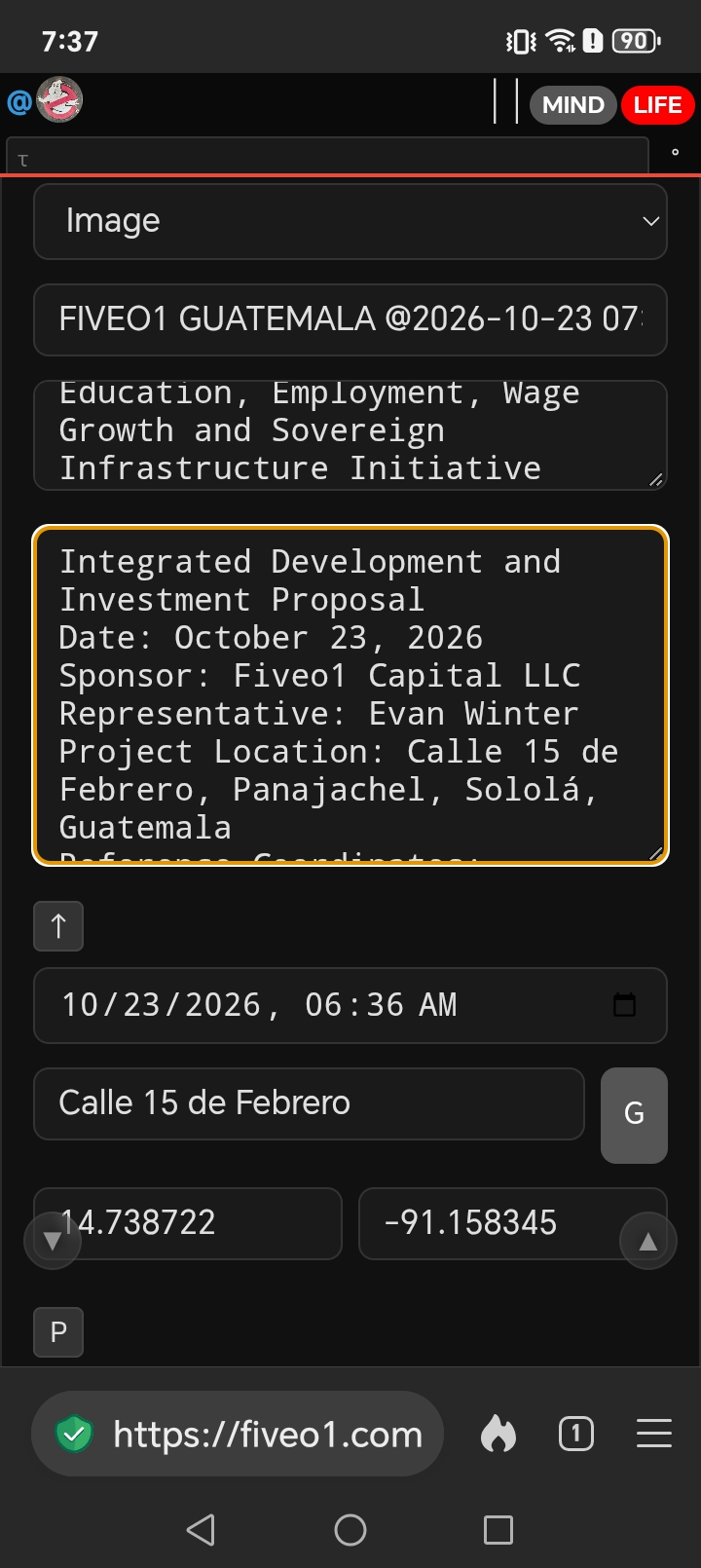
FIVEO1 GUATEMALA @2026-10-23 07:36:16 - Calle 15 de Febrero
Calle 15 de Febrero |
Integrated Development and Investment Proposal
Date: October 23, 2026
Sponsor: Fiveo1 Capital LLC
Representative: Evan Winter
Project Location: Calle 15 de Febrero, Panajachel, Sololá, Guatemala
Reference Coordinates: 14.738777, -91.158408
Headquarters Mailing Address: P.O. Box 312786, Avalon, California 90704, United States
Classification: Preliminary Development Proposal | Private & Confidential | Invitation Only
Fiveo1 — Top of the World. Development for Guatemala. Opportunity for Guatemalans.
---
1. EXECUTIVE SUMMARY
Fiveo1 Guatemala proposes an integrated, privately financed development initiative intended to expand access to education, create secure and continuous employment, increase wages, develop local businesses, strengthen essential infrastructure, and establish a premium golf, residential and hospitality destination in Guatemala.
The initiative combines the Fiveo1 Flagship Golf & Country Club concept, the Fiveo1 Sovereign Infrastructure Platform, a regional logistics and resource-development strategy, and a locally focused education and workforce-development program.
The proposed development is intended to connect international investment and premium tourism with measurable economic opportunities for Guatemalan citizens, particularly residents of Sololá and surrounding communities.
The initiative has six principal components:
1. Education: Tuition-free, locally accessible education and vocational training, subject to the establishment and funding of a dedicated education program.
2. Secure employment: Year-round employment opportunities in construction, hospitality, golf-course operations, engineering, agriculture, information technology, maintenance, logistics and administration.
3. Wage growth: Legally compliant starting wages, transparent pay scales, paid training, skills-based advancement and regular compensation reviews.
4. Golf and residential development: An internationally competitive 18-hole championship golf course, private country club, residential properties, hospitality facilities and a professional golf performance center.
5. Sovereign infrastructure: Resilient electricity, water treatment, wastewater management, secure computing, communications and disaster-recovery capabilities.
6. Local economic participation: Procurement from Guatemalan businesses, paid apprenticeships, locally recruited management, supplier development and opportunities for Guatemalan-owned enterprises.
The development is proposed as a private investment and operating initiative. It is not represented as an existing facility, an approved construction project, a secured investment, or a guaranteed source of employment. Land acquisition, financing, environmental authorization, municipal approvals, community consultation and technical feasibility remain prerequisites to implementation.
The principal public-benefit objective is to establish a development model in which the commercial operation supports durable employment, education, professional advancement and local economic participation rather than relying exclusively on construction activity or seasonal tourism.
1.1 Proposed development commitments
Subject to financing, feasibility and legal approval, Fiveo1 intends to establish the following program standards:
- Tuition-free participation for eligible Guatemalan residents in designated Fiveo1-funded education and vocational programs.
- Recruitment and training pathways for local residents before positions are offered to external candidates, where applicants meet the applicable qualifications.
- Year-round positions wherever operational requirements permit, with written employment terms and lawful benefits.
- Published salary bands and transparent promotion criteria.
- Paid apprenticeships and practical training linked to actual employment opportunities.
- Guatemalan supplier participation and local-business development.
- Public reporting of employment, training, wage progression, procurement, environmental performance and community benefits.
- Independent financial oversight and documented procurement procedures.
- Protection of Lake Atitlán, local water resources, land rights, cultural heritage and surrounding ecosystems.
These are proposed program standards, not claims that funding, eligibility rules, benefits or employment contracts have already been established.
2. DEVELOPMENT LOCATION AND REGIONAL CONTEXT
2.1 Primary reference location
Calle 15 de Febrero, Panajachel, Sololá, Guatemala
Coordinates: 14.738777, -91.158408
The coordinates identify the proposed reference location for the initiative. They do not establish ownership, a parcel boundary, zoning classification, available development acreage or construction suitability.
The first development phase must distinguish between the proposed location for project administration, a potential public-facing education and workforce center, and any separate parcel required for a championship golf course, residences, energy facilities, water treatment or other major infrastructure.
The 18-hole course and residential component require a separate site-selection process. A suitable parcel must be identified through cadastral research, title verification, landowner negotiations, geotechnical studies, water-resource analysis, environmental assessment, access planning and community consultation.
No specific acreage or construction footprint is considered secured at this stage.
2.2 Regional development area
The initial regional planning area includes:
- Panajachel and surrounding communities in Sololá.
- Communities around Lake Atitlán.
- Local agricultural and artisanal producers.
- Tourism, hospitality and transport businesses.
- Vocational schools, universities and technical-training providers.
- Regional construction, electrical, water, telecommunications and logistics companies.
- Potential suppliers and agricultural partners in other parts of Guatemala.
Regional expansion could subsequently connect the project to Guatemala City, Quetzaltenango, Escuintla and Pacific and Caribbean freight corridors, subject to commercial feasibility.
2.3 Local participation
The project is intended to serve Guatemalans as employees, students, suppliers, contractors, professionals and business owners.
Community participation must include consultation in appropriate local languages, accessible public information, documented feedback and a formal process for addressing grievances.
The project will not assume that all residents have the same economic interests or that one community representative speaks for every affected household.
3. EDUCATION FOR GUATEMALAN RESIDENTS
3.1 Tuition-free education program
Fiveo1 proposes to establish a dedicated education program funded through a combination of sponsor capital, operating allocations, education partnerships and, where available, separately committed philanthropic contributions.
Eligible participants would receive tuition-free instruction in approved courses. The final program must publish its eligibility requirements, annual budget, capacity, enrollment process, course availability and funding duration before enrollment begins.
The objective is to remove tuition as a barrier to participation in designated courses without implying that every education expense in Guatemala will automatically be covered.
Where necessary, the program may separately fund learning materials, practical equipment, examination fees, transportation assistance, meals or connectivity, provided those benefits are explicitly budgeted.
3.2 Educational pathways
The proposed curriculum includes:
Foundational education
- Literacy and numeracy support.
- Spanish-language instruction where needed.
- English for hospitality, business and international commerce.
- Digital literacy and computer operation.
- Mathematics, financial literacy and workplace communication.
Technical and vocational education
- Electrical installation and maintenance.
- Solar energy and battery systems.
- Plumbing, water treatment and wastewater operations.
- Refrigeration, air conditioning and building maintenance.
- Construction trades, surveying and project supervision.
- Hospitality, food preparation and hotel operations.
- Golf-course maintenance, irrigation and turf management.
- Landscaping, agriculture and sustainable cultivation.
- Automotive maintenance and fleet operations.
- Accounting, bookkeeping, purchasing and inventory management.
- Computer support, networking, cybersecurity and data operations.
- Logistics, warehouse management and transport coordination.
Professional development
- Supervisory and management training.
- Engineering and technical qualifications.
- Hospitality management.
- Business formation and entrepreneurship.
- Procurement, compliance and financial controls.
- Advanced technical study through accredited partner institutions.
3.3 Indigenous languages and cultural inclusion
Education delivery must recognize the linguistic and cultural diversity of Sololá and the Lake Atitlán region.
Where appropriate and operationally feasible, Fiveo1 will seek qualified instructors and educational partners able to provide instruction or support in relevant local Indigenous languages, including Kaqchikel and Tz'utujil.
The program must respect community identity, traditional knowledge, cultural property and local intellectual rights. Participation must not require the abandonment of a participant's language, cultural practices or community relationships.
3.4 Education linked to employment
Training will be designed around documented workforce requirements rather than enrollment targets alone.
Each participating training pathway should specify:
- Entry requirements.
- Course duration.
- Instructional language.
- Tuition and other covered expenses.
- Competencies to be demonstrated.
- Any recognized credential available.
- Related employment categories.
- Expected entry-level qualifications.
- Opportunities for advancement.
- Completion and employment outcomes.
A qualification will be described as accredited or officially recognized only when the relevant institution and authorization have been verified.
3.5 Education funding and accountability
A separately identified education account or restricted-budget structure is proposed to protect funds allocated to instruction and student support.
Annual reporting should disclose the amount committed, amount spent, number of enrolled participants, course-completion rate, qualifications earned, employment placements and funding available for the following year.
Tuition-free education will be sustained only to the extent that the program has committed and available funding. Long-term continuity requires a funded reserve or an enforceable multiyear funding arrangement rather than an unfunded promise.
4. SECURE, CONTINUOUS EMPLOYMENT
4.1 Employment objective
Fiveo1 proposes to develop a permanent workforce supporting the golf club, residences, hospitality facilities, education center, technical infrastructure, agricultural operations and regional supplier network.
The objective is to create employment that continues beyond the initial construction period and is not dependent exclusively on seasonal visitor demand.
Employment planning will distinguish between:
1. Temporary construction employment.
2. Permanent operating positions.
3. Fixed-term specialist contracts.
4. Paid apprenticeships and supervised training.
5. Independent suppliers and contractors.
6. Management and professional positions.
No employment total is represented as guaranteed before the site plan, construction schedule, operating model and staffing requirements have been completed.
4.2 Anticipated employment categories
Construction and engineering
- Civil engineers and construction supervisors.
- Surveyors and site technicians.
- Electricians, plumbers and mechanics.
- Masonry, carpentry and finishing trades.
- Equipment operators.
- Safety officers and environmental technicians.
Golf and grounds
- Course superintendent and assistant superintendents.
- Agronomists and irrigation technicians.
- Turf and landscape teams.
- Golf professionals and instructors.
- Caddies, forecaddies and starter personnel.
- Equipment mechanics and grounds supervisors.
Hospitality and residential services
- Hotel and guest-service personnel.
- Chefs, cooks, servers and food-service managers.
- Housekeeping and maintenance teams.
- Spa, fitness and recreation staff.
- Residential property management.
- Concierge, transport and guest logistics.
Infrastructure and technology
- Electrical and microgrid technicians.
- Water and wastewater operators.
- Solar and battery-system technicians.
- Network administrators.
- Cybersecurity and computing personnel.
- Communications and backup-system technicians.
Administration and business
- Accountants and finance personnel.
- Human resources and training coordinators.
- Purchasing and procurement staff.
- Legal and compliance specialists.
- Sales, reservations and event-management personnel.
- Local supplier and community liaison officers.
4.3 Local recruitment
The initial recruitment program should prioritize qualified applicants from Panajachel, Sololá and nearby communities.
Recruitment criteria must be documented and applied consistently. Positions requiring specialized qualifications may be filled through wider national or international recruitment when those qualifications are unavailable locally.
External specialists should, where practical, participate in structured knowledge transfer, local trainee supervision and succession planning.
The project should publish the proportion of employees recruited from the surrounding region, the proportion of management roles held by Guatemalans and the number of local employees promoted into higher-skilled positions.
4.4 Secure employment standards
The proposed employment framework includes:
- Written employment agreements.
- Compliance with Guatemalan labor law and applicable minimum wages.
- Timely wage payment.
- Applicable social-security registration and statutory benefits.
- Occupational health and safety procedures.
- Documented working hours, overtime and leave.
- Protection against unlawful discrimination and harassment.
- Formal grievance and complaint procedures.
- Paid training where required or agreed.
- Transparent termination and disciplinary procedures.
The project should use permanent or indefinite-duration employment contracts for ongoing positions where the nature of the work and applicable law support that arrangement.
No private initiative can guarantee that every job will remain permanent under all economic circumstances. Continuity will depend on operating revenue, financing, demand, employee performance and lawful employment arrangements.
5. WAGE GROWTH AND CAREER ADVANCEMENT
5.1 Compensation framework
Fiveo1 proposes a wage structure based on role, skill, certification, responsibility, experience and performance.
The purpose is to create a pathway from entry-level work to skilled employment, supervisory positions and professional careers.
All compensation must meet or exceed the applicable Guatemalan legal requirements. The applicable 2026 minimum wage depends on the economic activity and geographic classification; the project must verify the correct rate for each job before hiring. The statutory minimum is a legal floor, not the proposed long-term wage target. [Official reference: Ministry of Labor, Guatemala, https://mintrabajo.gob.gt/salario-minimo/]
5.2 Wage progression
The proposed structure consists of five levels:
Level 1 — Entry and trainee
- Defined entry-level duties.
- Paid training and supervision.
- A documented skills assessment.
- Eligibility to progress after meeting published requirements.
Level 2 — Qualified employee
- Demonstrated competence in the assigned occupation.
- Relevant technical or vocational training where required.
- Higher pay associated with the qualified role.
Level 3 — Senior or specialist
- Advanced technical capability or significant occupational experience.
- Responsibility for complex work, equipment or quality standards.
- Eligibility for specialist and lead-worker positions.
Level 4 — Supervisor or manager
- Team leadership and operational responsibility.
- Training in safety, scheduling, quality, budgeting and personnel management.
- A compensation band reflecting supervisory accountability.
Level 5 — Professional and executive
- Specialized professional qualifications or demonstrated senior-level capability.
- Responsibility for departments, technical systems, finances or business operations.
- Compensation determined by role scope, performance, market conditions and applicable law.
Movement between levels must be based on documented qualifications and performance criteria rather than informal favoritism.
5.3 Wage-growth policy
Fiveo1 proposes:
- Annual compensation reviews.
- Published salary bands for comparable positions.
- Additional pay for higher qualifications and expanded responsibility.
- Promotion opportunities for qualified internal candidates.
- Training that enables workers to qualify for higher-paying positions.
- Clear separation between base pay, legally required benefits, discretionary bonuses and other allowances.
- Regular analysis of local labor-market conditions and the cost of living.
A specific wage-growth percentage will not be represented as guaranteed until a compensation budget, revenue model and applicable job classifications have been approved.
5.4 Employee development
The project should measure wage progression using the median starting wage, median wage by occupational level, percentage of workers receiving promotions, retention rates and changes in real compensation after inflation.
Training will be evaluated by whether participants gain recognized competencies, move into higher-skilled work or improve their earning capacity—not solely by the number of courses delivered.
6. FIVEO1 FLAGSHIP GOLF & COUNTRY CLUB
6.1 Project concept
The Fiveo1 Flagship Golf & Country Club is proposed as the premium commercial and hospitality component of the wider development initiative.
Its purpose is to attract high-value visitors, residential buyers, private members, international sporting events and investment while generating demand for Guatemalan workers and suppliers.
The original flagship concept was developed around coastal California. The Guatemala version requires a new site-specific design, financial model, climate assessment and environmental review. California land prices, construction costs, climate assumptions and entitlement assumptions cannot be treated as validated Guatemalan estimates.
6.2 Championship course
The preliminary design benchmark is an 18-hole, par-72 championship course measuring approximately 7,446 yards from the back tees, subject to land availability and site-specific engineering.
The design objectives include:
- A walkable course.
- A mandatory caddie program during designated operating periods.
- Firm playing surfaces where compatible with local conditions.
- Strategic bunkering, native landscape features and varied green complexes.
- A professional practice and short-game facility.
- A course capable of hosting high-level tournaments if the necessary sporting, operational and venue standards are achieved.
The original design includes three character zones:
- The Cliffs: Holes 1–3 and 16–18.
- The Dunes and Meadow: Holes 4–9.
- The Forest: Holes 10–15.
These are conceptual design themes, not verified descriptions of the proposed Guatemalan land. The final layout must reflect the actual topography, soils, vegetation, water availability and environmental constraints of the selected parcel.
6.3 Preliminary 18-hole design schedule
The following course names and specifications preserve the original design concept. They are subject to redesign and feasibility review in Guatemala.
Hole| Name| Par| Yards
1| The Handshake| 4| 435
2| Devil's Frying Pan| 3| 185
3| The Cliff Walk| 5| 610
4| The Meadow| 4| 480
5| The Keyhole| 4| 388
6| Sunset Ridge| 3| 225
7| The Old Orchard| 5| 590
8| Postage Stamp| 3| 128
9| Amphitheater| 5| 590
10| The Descent| 4| 445
11| Cathedral Pines| 4| 505
12| The Bell| 3| 165
13| Ridge Line| 5| 640
14| The Wine Terrace| 4| 430
15| The Decision| 3| 190
16| Bear's Cliff| 4| 500
17| The Short Four| 4| 340
18| The Fiveo1 Finale| 5| 600
Total| 18 holes| 72| 7,446
The original design includes a ceremonial opening tee shot, distinctive short and long holes, a double-dogleg par five, a short risk-reward par four, a signature championship hole and a closing hole featuring a Fiveo1 monolith.
Any water hazard, cliff-edge feature, protected habitat, mature tree, pond or other site-specific feature must be designed only where it is physically present, legally permissible and environmentally acceptable.
6.4 Practice campus
The original practice-campus concept includes:
- A 22-acre double-ended driving range.
- Four target greens.
- Eight short-game practice areas.
- Two bunker practice studios.
- TrackMan and GEARS golf-analysis technology.
- A lighted putting course called the Fifty-One Steps.
- A covered 60-bay technology-enabled hitting pavilion.
The size and equipment package must be reassessed against the selected parcel, water availability, construction budget and expected operating demand.
6.5 Golf education and employment
The course should support local employment and skills development through:
- Caddie training.
- Golf instruction and junior development.
- Turf and agronomy education.
- Irrigation and equipment maintenance training.
- Golf operations and tournament management.
- Hospitality and event-service training.
A professional golf facility may create jobs beyond the golf course itself through accommodation, food service, transportation, maintenance, construction, events and supplier contracts.
These opportunities are anticipated employment categories, not a quantified job forecast.
7. CLUBHOUSE, HOSPITALITY AND RESIDENTIAL DEVELOPMENT
7.1 The Lodge at Fiveo1
The preliminary architectural concept is a clubhouse of approximately 65,000 square feet, using locally appropriate stone, timber and other materials sourced subject to quality, legality and sustainability requirements.
Proposed facilities include:
- Formal dining with approximately 90 seats.
- A members' grill.
- A terrace bar.
- A wine cellar designed for approximately 12,000 bottles.
- Spa, pool and fitness facilities.
- A 24-suite guest lodge.
- Eight event venues, including a pavilion designed for approximately 400 guests.
- A private automotive gallery.
- Administrative, employee, storage and service areas.
Final capacity, design and operating arrangements must comply with applicable fire, sanitation, construction, accessibility and hospitality requirements.
7.2 Residential portfolio
The original concept includes 180 residential units in three categories.
Residential category| Units| Original design concept
Founders Estates| 48| One- to two-acre lots, with homes capped at 15,000 square feet
Villas at the Links| 96| Club-managed homes of approximately 4,200–7,500 square feet
Golf Cottages| 36| Two- to three-bedroom residences near the clubhouse
Total| 180| Subject to revised Guatemalan feasibility
The California concept's original price ranges were $3.5 million–$8.5 million for Founders Estates lots, $5 million–$14 million for villas and $1.8 million–$3.2 million for cottages.
These are original California concept prices, not Guatemalan market valuations, proposed local housing prices or verified estimates of achievable sales.
The Guatemala residential component requires independent local market research, land valuation, demand testing, infrastructure costing, tax analysis and legal review. The project must not represent these original prices as evidence of Guatemalan demand or financial viability.
7.3 Residential participation
Residential acquisition in the original concept is tied to club membership approval. The Guatemala project must establish transparent and lawful eligibility criteria before marketing or accepting deposits.
Residential development should be phased so that it does not consume funds committed to education, employee obligations, essential infrastructure or environmental protection.
The project should separately assess opportunities for employee accommodation and workforce transportation. Luxury residences are not a substitute for affordable housing or a guarantee of housing access for employees.
8. MEMBERSHIP AND CLUB OPERATIONS
8.1 Proposed membership structure
The original flagship model caps total membership at 600.
Membership category| Maximum members| Original initiation fee
Founding Equity| 100| $250,000
Standard Equity| 460| $150,000
Corporate| 40| $400,000
Total| 600| —
The proposed annual dues are $24,000 per member.
At full capacity, the stated tier structure produces approximately $110 million in gross initiation revenue and $14.4 million in annual dues before collection losses, taxes, operating expenses, capital reserves or other deductions.
These are calculations based on the original proposed fees and membership limits. They are not secured revenue, operating profit or evidence of demand in Guatemala.
The final Guatemalan membership structure must be established through local market research, legal review, tax analysis and currency-risk assessment.
8.2 Local economic participation
The club should establish a local supplier program covering food, agricultural products, landscaping materials, maintenance, transport, construction, furnishings and professional services.
Supplier selection should consider quality, price, reliability, legal compliance, environmental standards and the ability of Guatemalan enterprises to meet documented specifications.
Where local suppliers need additional capability, Fiveo1 may offer procurement guidance, training, transparent tender requirements and staged contracting opportunities.
No supplier should be promised a contract solely because of geographic location, and no public official or private intermediary should receive an undisclosed payment or personal benefit for procurement decisions.
9. FINANCIAL CAPITAL FRAMEWORK
9.1 Original flagship budget
The original California concept included the following preliminary development budget.
Budget category| Original estimate
Land acquisition| $300 million
Entitlements, environmental review and legal| $35 million
Golf architecture and engineering| $5 million
Course construction and practice grounds| $55 million
Irrigation, turf, paths and landscape| $18 million
Clubhouse and furnishings| $150 million
Spa, pool, guest lodge and operations complex| $50 million
Vineyard and agricultural amenities| $5 million
Audi Ramco Performance Center| $20 million
Operations and food-service startup capital| $8 million
Residential infrastructure| $75 million
Phase 1 villa and cottage construction| $150 million
Contingency| $87 million
Original stated base case| Approximately $958 million
The original stated total is a preliminary California concept estimate. It must not be represented as an audited total or an appropriate budget for Guatemala. Individual line items, sponsor-funded components, contingencies and possible overlaps require reconciliation.
A new Guatemalan financial model must use locally sourced land valuations, quantities, labor costs, construction bids, tax assumptions, import costs, exchange rates, financing terms, environmental mitigation costs and operating forecasts.
9.2 Guatemala investment model
The project should be developed through a staged capital plan.
Stage 1 — Feasibility and safeguards
- Site and title investigation.
- Community consultation.
- Legal, environmental and water-resource review.
- Market demand analysis.
- Preliminary engineering.
- Education and employment needs assessment.
- Initial operating and capital model.
Stage 2 — Initial community and workforce facilities
- Education and training facilities.
- Recruitment and supplier-development program.
- Essential utility assessments and approved infrastructure.
- Local workforce preparation.
- Management, accounting and compliance systems.
Stage 3 — Core commercial development
- Construction of approved golf, clubhouse, hospitality and practice facilities.
- Installation of essential utilities and resilience systems.
- Recruitment and operational training.
- Phased opening after required inspections and authorizations.
Stage 4 — Residential development
- Construction in phases tied to verified demand and financing.
- Completion of supporting roads and utilities.
- Protection of funds committed to employee and education obligations.
Stage 5 — Regional expansion
- Additional education and vocational partnerships.
- Agricultural, logistics and supplier-network development.
- Further infrastructure facilities where technically and commercially justified.
No later stage should be treated as funded merely because an earlier stage has been proposed.
9.3 Financial transparency
Fiveo1 should establish the following controls:
- Separate accounting for development capital, operating expenditure and education funds.
- Written approval limits for expenditure.
- Competitive procurement and documented contract awards.
- Conflict-of-interest declarations.
- Independent financial audits.
- Verification of construction progress against payments.
- Published annual budget-to-actual reporting.
- Documented procedures for complaints and suspected misconduct.
The project should distinguish clearly between capital committed, capital received, contractual liabilities, projected sales, collected revenue, operating income and distributable profit.
10. PRESENTING PARTNERSHIP AND INTERNATIONAL INVESTMENT
10.1 Audi Ramco concept
The original proposal identifies Audi Ramco as the intended presenting partner under the title “Audi Ramco presents The Fiveo1 Club.”
The original commercial concept specifies:
- A ten-year presenting partnership.
- $18 million in cash rights fees.
- $14 million toward a dedicated golf performance center.
- A fleet of 14 premium vehicles.
- Fleet replacement approximately every 24 months.
- An annual member-guest invitational.
- Quattro-themed experiences and new-model presentations.
- Limited permanent sponsor signage.
- No sponsor presence within specified member sightlines on holes 11–15.
The original stated ten-year partner commitment is approximately $52 million when cash fees, capital contributions, fleet and activation value are included.
This is a proposed commercial package, not a verified agreement. The value attributed to vehicles, activation, rights and capital expenditure must be supported by contracts and accounting records.
The partnership must not be represented as executed or funded unless documentary evidence establishes that status.
10.2 Partner standards
Any international presenting partner should be subject to:
- Verified legal identity and contracting authority.
- Written scope of rights and obligations.
- Documented cash and non-cash contributions.
- Clear ownership of equipment and facilities.
- Tax and import compliance.
- Anti-bribery and conflict-of-interest controls.
- Environmental and employment standards.
- Termination and dispute-resolution provisions.
The commercial partnership should not control education admissions, public procurement, local political participation or access to public services.
10.3 Other potential investment categories
Potential counterparties may include golf-course designers, construction firms, renewable-energy providers, water-treatment specialists, telecommunications providers, hospitality operators, educational institutions and international tourism businesses.
They are prospective counterparties unless a signed agreement or independently verifiable commitment establishes otherwise.
11. FIVEO1 SOVEREIGN INFRASTRUCTURE PLATFORM
11.1 Purpose
The Fiveo1 Sovereign Infrastructure Platform is intended to support reliable local operations through integrated energy, water, computing, communications and resilience systems.
For the Guatemala initiative, the platform would be designed around actual local infrastructure conditions and applicable Guatemalan law. The term “sovereign” describes the proposed operational and data-control objective; it does not imply sovereign-state status or exemption from national regulation.
11.2 Energy resilience
The proposed energy system may combine:
- Grid electricity.
- On-site solar generation where technically suitable.
- Battery storage.
- Efficient electrical equipment.
- Backup generation where necessary and legally permitted.
- Load management and power monitoring.
- Critical-load separation for communications, security and essential operations.
Engineering studies must establish peak demand, annual consumption, storage capacity, backup duration, grid connection requirements, emissions and lifecycle costs.
No uninterrupted-power guarantee should be made until the system has been designed, installed, tested and maintained to a documented standard.
11.3 Water and wastewater
Water security is a critical planning requirement for a development near Lake Atitlán.
The proposed system may include:
- Water-demand reduction.
- Metering and leak detection.
- Rainwater collection where permitted.
- Treatment and reuse of wastewater.
- Recycled water for suitable irrigation applications.
- Efficient irrigation design.
- Water-quality monitoring.
- Emergency water storage.
- Independent testing and maintenance records.
Reverse-osmosis treatment should be considered only where the source-water characteristics and engineering analysis justify it. It is not a substitute for sustainable abstraction or adequate wastewater treatment.
The project must quantify water demand for residents, visitors, irrigation, food service, accommodation and employees before committing to a course design.
No discharge, groundwater extraction, lake-water abstraction or wastewater reuse should proceed without the required technical assessment and authorizations.
11.4 Computing and data resilience
The proposed platform includes edge computing, secure local storage, redundant connectivity and off-site disaster recovery.
Potential applications include:
- Facility management.
- Utility monitoring.
- Environmental data collection.
- Equipment maintenance.
- Workforce and training administration.
- Secure business records.
- Geospatial mapping.
- Time-stamped photo and video archiving.
- Backup communications and disaster recovery.
The platform should use access controls, encryption, logging, backup testing, data-retention policies and incident-response procedures.
Personal information, employee records, student information and community data must be collected and processed only for defined purposes with appropriate security and legal safeguards.
11.5 Regional resilience
The broader Fiveo1 infrastructure strategy identifies Guatemala City, Quetzaltenango, Escuintla and Pacific and Caribbean logistics corridors as potential areas for future infrastructure and business coordination.
Any regional node must have a defined operational purpose, technical design, ownership structure, financing plan and verified demand. The existence of a regional concept does not establish that infrastructure has been constructed or contracted.
12. ENVIRONMENTAL PROTECTION AND LAKE ATITLÁN
12.1 Environmental baseline
Before land acquisition or construction, the project should commission independent studies covering:
- Topography, geology and slope stability.
- Soil characteristics and erosion risk.
- Watersheds and surface-water drainage.
- Groundwater and water availability.
- Wastewater and stormwater management.
- Biodiversity and habitat.
- Agricultural land and existing land use.
- Cultural and archaeological heritage.
- Traffic, noise, air quality and construction impacts.
- Climate exposure and natural hazards.
The findings must inform the final site boundary, building footprint, golf-course design and development schedule.
12.2 Lake protection
The project should avoid treating the lake as an unlimited source of water or as a destination for untreated or inadequately treated discharge.
The environmental management plan should establish measurable limits and monitoring for water consumption, wastewater quality, erosion, sediment, fertilizer use, pesticide use, solid waste and habitat disturbance.
Golf-course turf and planting plans should be based on local agronomy and water availability. Salt-tolerant or coastal California planting assumptions must not be transferred automatically to the Lake Atitlán region.
Fertilizers and pesticides should be selected and applied under a documented integrated pest-management program, with controls designed to minimize runoff.
12.3 Regulatory compliance
The project must identify and comply with all applicable national and municipal requirements, including those governing environmental assessment, construction, water, wastewater, protected areas, cultural heritage, labor, public health and land use.
The competent authorities must determine which approvals and environmental instruments apply to each proposed component.
12.4 Community and land rights
Before any parcel is acquired or developed, Fiveo1 should verify legal title, encumbrances, access rights, applicable communal or collective land interests and any claims or restrictions affecting the property.
Consultation must take place early enough to influence project design. Where Indigenous peoples' rights or applicable consultation requirements are engaged, the project must follow the relevant legal framework and respect applicable community rights.
Environmental compliance and community participation are prerequisites to development, not post-construction additions.
13. GUATEMALA'S PUBLIC FINANCES AND INSTITUTIONAL CONTEXT
13.1 Audit findings and public accountability
Guatemala's public-finance and governance context supports the need for transparent project administration, independent verification and clearly documented financial controls.
The revised Fiveo1 Guatemala briefing reports that the Contraloría General de Cuentas presented findings relating to the 2025 state-budget liquidation, including reported findings of Q9,006,096,098.94 and 114 criminal complaints valued at Q8,771,788,089.10.
These figures describe reported audit findings and complaints as attributed in the briefing. They must not be described as a judicial determination that the entire amount was stolen, lost or finally proven to have been misused. Administrative audit findings, referrals, complaints, prosecutions and final judicial judgments are different categories.
Before this initiative republishes those figures as verified primary-source data, the relevant official audit report and its tables should be checked directly against the original documents.
13.2 Corruption-risk controls
Fiveo1 should adopt a compliance framework that includes:
- Independent accounting and annual external audit.
- Competitive procurement.
- Published supplier-selection criteria.
- Written approval and payment records.
- Verification of work completed before contractor payments.
- Beneficial-ownership checks for significant counterparties.
- Conflict-of-interest declarations.
- Anti-bribery and anti-fraud policies.
- Secure reporting channels.
- Protection against retaliation for good-faith reports.
- Document retention and independent investigation procedures.
No political endorsement, government relationship, charitable contribution or sponsorship should be represented as proof that a contract is lawful or commercially justified.
13.3 Economic context
Banco de Guatemala figures reported for 2025 indicate that Guatemala received approximately US$25.53 billion in family remittances. This demonstrates the scale of income sent home by Guatemalans abroad; it does not establish the amount available to finance this project or predict local purchasing power. [Source: Agencia Guatemalteca de Noticias, January 8, 2026, https://agn.gt/guatemala-alcanza-record-historico-de-25-mil-millones-de-dolares-en-remesas-familiares-durante-2025/]
Transparency International's 2025 Corruption Perceptions Index gave Guatemala a score of 26 out of 100 and a ranking of 142 among 182 countries and territories. The index measures perceived public-sector corruption; it is not an audit of any individual organization or a measurement of the amount of money misused. [Source: https://www.transparency.org/en/cpi/2025]
These indicators establish relevant national context. They do not establish the feasibility, financing or anticipated results of the Fiveo1 initiative.
14. AGRICULTURE, FOOD AND LOCAL SUPPLIER DEVELOPMENT
The project should establish procurement pathways for qualified Guatemalan producers and small businesses.
Potential categories include:
- Fruits, vegetables and other agricultural products.
- Coffee and other locally produced beverages.
- Bakery, dairy and prepared food products.
- Flowers, plants and landscaping materials.
- Furniture, woodwork, stonework and furnishings.
- Textiles, uniforms and hospitality supplies.
- Maintenance, cleaning and repair services.
- Transportation and logistics.
- Printing, information technology and business services.
Supplier development should include transparent product specifications, quality and food-safety requirements, purchasing schedules, payment terms and an accessible tender process.
Fiveo1 should measure the value and percentage of eligible procurement awarded to Guatemalan suppliers, including the portion awarded to small and locally owned businesses.
Contracts should provide commercially reasonable payment terms so that smaller suppliers are not required to finance the project's operations indefinitely.
Agricultural partnerships must account for seasonal supply, water availability, land rights, food safety and the economic interests of existing producers.
15. EMPLOYEE AND COMMUNITY BENEFITS
15.1 Proposed employee benefits
Subject to the final employment policy, budget and applicable law, the project should consider:
- Tuition-free access to designated training.
- Paid apprenticeships.
- Employer-supported certification.
- Career counseling and internal recruitment.
- Meals or meal assistance during qualifying shifts.
- Transportation support where operationally justified.
- Occupational safety equipment.
- Employee assistance and grievance channels.
- Performance-based advancement.
- Access to selected health, fitness or recreation facilities under published rules.
Statutory benefits must be distinguished from additional benefits funded voluntarily by the employer.
15.2 Community benefits
The proposed community-benefit program should include:
- Local hiring and training.
- Education partnerships.
- Local supplier access.
- Environmental monitoring and reporting.
- Public information sessions.
- A documented grievance process.
- Transparent reporting of community-benefit expenditure.
- Coordination with appropriate educational and community organizations.
Donations and community programs must have published selection criteria, documented recipients and financial records.
The project must not condition access to lawful public services, employment rights or community participation on political support, religious affiliation or personal loyalty.
16. GLOBAL NETWORK AND INTERNATIONAL EXPANSION
The original Fiveo1 concept proposes an eight-club international network by Year 14, with a portfolio target of approximately 4,800 members and approximately $7 billion in cumulative residential sales.
The original candidate markets are:
1. Flagship location, originally Monterey or Palos Verdes, California.
2. Sotogrande or Costa del Sol, Spain.
3. Dubai or Abu Dhabi, United Arab Emirates.
4. Fiji, including the Mamanuca or Nadi coast.
5. Hawaii, potentially Kauai or the Big Island.
6. Bukit Peninsula, Bali.
7. Comporta or Alentejo, Portugal.
8. Queenstown, New Zealand.
Additional candidate markets include Lake Como, Monaco or the French Riviera, Sentosa, Scottsdale, Cabo San Lucas, Jeju Island and Hokkaido.
For the Guatemala initiative, the proposed Panajachel development would require a formal decision on whether it replaces the original California flagship in the network or operates as a distinct Central American development.
Until that decision is made, Guatemala should not be counted as a confirmed eighth location or assumed to share the original portfolio's financial projections.
The eight-club network, membership target and cumulative sales figure are long-range planning objectives, not verified forecasts or secured commitments.
Expansion must be conditional on the performance of the first operating project, independent financial analysis, local legal compliance and the availability of capital.
17. PROJECT GOVERNANCE AND OPERATING STRUCTURE
17.1 Proposed corporate structure
The proposed structure is:
Fiveo1 Capital LLC
Strategic sponsorship, capital coordination and project oversight.
Guatemala operating entity
Local contracting, employment, licensing, tax compliance and daily operations.
Dedicated operating divisions or subsidiaries
- Golf and country club.
- Hospitality and residential operations.
- Education and workforce development.
- Energy and water infrastructure.
- Computing and communications.
- Agriculture and supplier development.
The final structure must be reviewed by qualified Guatemalan legal and tax professionals. Entity names, registrations, ownership and operational responsibilities must be confirmed before being represented as established.
17.2 Governance controls
The project should establish:
- A board or equivalent governing body with documented responsibilities.
- Written financial delegation limits.
- Independent oversight of education funds.
- Employment and compensation policies.
- Environmental and safety management systems.
- Procurement and conflict-of-interest procedures.
- Annual financial reporting.
- A risk register and corrective-action process.
- A formal complaints and whistleblowing mechanism.
Any partnership with a public body must comply with applicable law and must not imply public endorsement where none exists.
17.3 Independent verification
Project performance should be measured against published targets and independently reviewed where practical.
Reports must distinguish between actual results, estimates, forecasts, approved budgets, uncommitted proposals and unverified claims.
The initiative must not publish unsupported employment totals, guaranteed wage increases, guaranteed investment returns, environmental certifications or partner commitments.
18. IMPLEMENTATION ROADMAP
Phase 1 — Feasibility, legal review and consultation
- Verify the reference coordinates and identify candidate parcels.
- Commission title, cadastral, zoning and access reviews.
- Conduct environmental, hydrological, geological and engineering assessments.
- Consult affected communities and relevant institutions.
- Complete a regional employment and education needs assessment.
- Establish a preliminary capital and operating model.
- Determine the required approvals and applicable labor, tax and environmental obligations.
Completion condition: Documented feasibility findings and a decision to proceed, redesign or stop.
Phase 2 — Funding and project formation
- Establish the appropriate Guatemalan legal and operating entities.
- Secure and document capital commitments.
- Approve the initial development budget.
- Establish accounting and independent oversight.
- Finalize the education and workforce funding model.
- Prepare procurement, recruitment, environmental and community policies.
Completion condition: Verifiable financing, legal authority and approved project controls sufficient for the proposed initial phase.
Phase 3 — Education and workforce preparation
- Select qualified educational partners.
- Publish tuition-free program eligibility and course terms.
- Recruit the first student and trainee cohorts.
- Establish occupational training standards.
- Identify verified vacancies and employer requirements.
- Develop local supplier registration and qualification procedures.
Completion condition: Funded courses, qualified instructors, documented enrollment terms and defined employment pathways.
Phase 4 — Approved construction and infrastructure
- Procure qualified contractors.
- Complete approved infrastructure works.
- Establish environmental monitoring.
- Install and test essential utility systems.
- Verify construction progress before payments.
- Recruit and train operational employees.
Completion condition: Required inspections, permits and operational readiness for each component being opened.
Phase 5 — Operations and wage progression
- Open facilities in approved stages.
- Implement published salary bands.
- Conduct regular performance and compensation reviews.
- Measure employment retention and internal promotions.
- Report education, wage and supplier outcomes.
- Correct environmental, operational or compliance deficiencies.
Completion condition: Measurable operational performance and verified compliance.
Phase 6 — Expansion
- Evaluate commercial performance.
- Reassess education and employment demand.
- Expand only where additional financing and capacity are demonstrated.
- Develop regional supplier and infrastructure relationships.
- Consider further international locations only after the relevant feasibility studies.
Completion condition: Independent evidence that expansion is financially and operationally supportable.
19. PERFORMANCE INDICATORS
The project should publish a defined baseline before setting numerical outcome targets.
Area| Required performance measure
Education| Enrollment, attendance, completion and qualifications earned
Tuition-free access| Eligible students enrolled without tuition charges
Employment| Total employees, new hires and employment category
Local hiring| Share of employees recruited from the defined regional area
Employment security| Contract type, retention and year-round positions
Wages| Median starting pay, occupational pay bands and annual changes
Career progression| Promotions, completed training and internal placements
Supplier development| Total local procurement and participating Guatemalan businesses
Financial control| Budget-to-actual reporting and independent audit results
Environment| Water use, wastewater compliance, energy use and waste management
Community engagement| Consultations, grievances received and resolutions completed
Infrastructure| Reliability, outages, backup tests and maintenance performance
Residential development| Units approved, built, sold and occupied
Commercial operations| Membership, occupancy, revenue and operating expenses
Every published indicator should identify its measurement period, definition, source and verification method.
Numerical targets should be set only after feasibility studies establish the resources and baseline needed to achieve them.
20. PRINCIPAL RISKS AND MITIGATION
Land and title risk: Verify ownership, access, encumbrances and relevant land rights before acquisition or construction.
Environmental risk: Complete independent environmental and water assessments; redesign or reject components that cannot meet applicable requirements.
Financing risk: Use staged investment, verified commitments, contingency reserves and independent cost reviews.
Demand risk: Test local and international demand before relying on residential sales, memberships or hospitality revenue.
Construction risk: Use qualified contractors, fixed scopes where appropriate, progress verification, insurance and documented change orders.
Employment risk: Base recruitment on funded positions and establish a realistic permanent operating model beyond the construction period.
Wage sustainability risk: Tie compensation commitments to an approved operating budget while preserving statutory employee rights.
Education continuity risk: Protect committed education funding and disclose the duration and conditions of tuition-free support.
Governance risk: Use independent audits, procurement controls, transparent approvals and formal reporting channels.
Water and energy risk: Engineer capacity from measured demand, reliable supply assessments and tested contingency arrangements.
Community risk: Consult affected residents early, disclose project impacts and maintain an accessible grievance process.
Reputation risk: Describe unexecuted agreements, forecasts and proposed benefits accurately; correct material errors promptly.
21. FINAL DEVELOPMENT OBJECTIVE
Fiveo1 Guatemala is proposed as a commercially operated development with explicit social and economic objectives.
The intended outcome is a connected system in which international investment supports:
- Tuition-free access to designated education and training.
- Continuous employment wherever operationally viable.
- Wage progression through qualifications and skills.
- Greater participation by Guatemalan employees, managers and suppliers.
- Premium golf, residential and hospitality operations.
- Resilient energy, water, communications and computing systems.
- Environmental protection and responsible resource use.
- Transparent financial administration.
- Long-term regional economic participation.
The development must be judged by documented results: the quality and duration of employment, actual wage progression, education completed, local purchasing, environmental compliance and financial sustainability.
The proposal does not substitute for financing, legal approvals, environmental authorization, land acquisition, community consultation or enforceable employment and education commitments. Those steps are necessary to convert the initiative from a development concept into an operating project.
---
22. FORMAL CORRESPONDENCE
Fiveo1 Capital LLC
P.O. Box 312786
Avalon, California 90704
United States of America
Attention: Evan Winter
Subject: Fiveo1 Guatemala — Indigenous Development, Education, Employment, Wage Growth and Sovereign Infrastructure Initiative
Formal correspondence, investment submissions and partnership proposals may be directed to the mailing address above. ← Back to Fiveo1