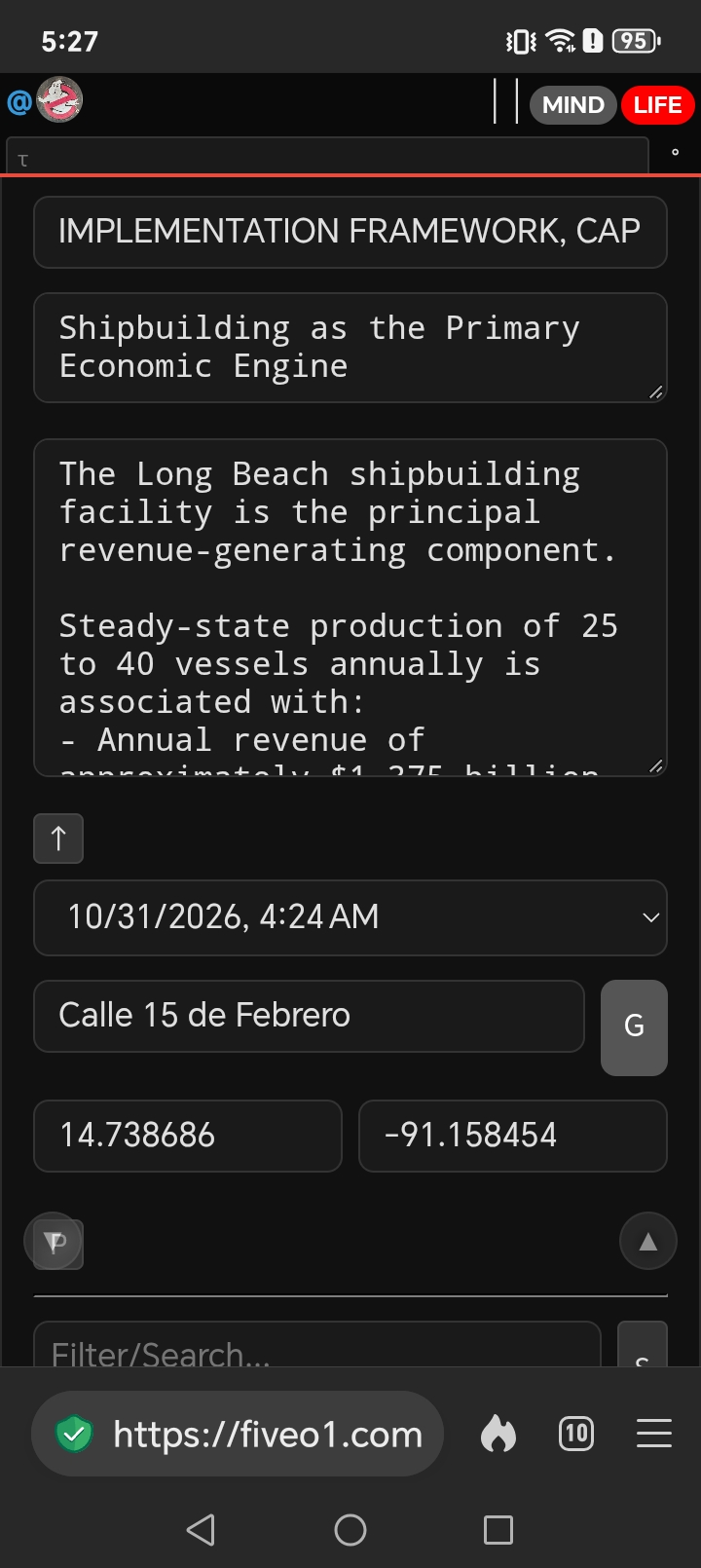
IMPLEMENTATION FRAMEWORK, CAPITAL STRUCTURE, AND REGIONAL Integration @2026-10-31 05:26:16 - Calle 15 de Febrero
Calle 15 de Febrero |
The Long Beach shipbuilding facility is the principal revenue-generating component.
Steady-state production of 25 to 40 vessels annually is associated with:
- Annual revenue of approximately $1.375 billion to $2.2 billion.
- Operating profit of approximately $110 million to $220 million.
- Direct employment of 3,000 to 5,000 workers.
- Direct labor income of approximately $240 million to $500 million annually.
Using published shipbuilding-sector multiplier estimates, total supported employment ranges from approximately 10,800 to 18,500 jobs nationally, with concentration in Southern California from facility operations, workforce spending, engineering, logistics, maintenance, and supplier activity.
The Long Beach location provides direct access to one of the largest port complexes in the United States and avoids infrastructure limitations identified for Catalina Island.
Catalina Island Role
Catalina Island involvement is limited to energy development, research, support operations, tourism, and related commercial activity.
Infrastructure, transportation, environmental-review, water-supply, and workforce constraints make large-scale industrial shipbuilding more difficult on Catalina Island than on mainland sites. Large-vessel construction remains centered in the Long Beach area.
Workforce Development System
National shipbuilding labor shortages are a principal risk.
A phased training model consists of:
- Apprenticeship programs.
- Trade-school partnerships.
- Community-college partnerships.
- Veteran-transition employment programs.
- Maritime engineering and design programs.
- Fabrication, welding, electrical, pipefitting, and logistics training.
This system supports staffing of 3,000 to 5,000 direct workers during steady-state operations.
Central American Integration
The Guatemala proposal functions as a regional development component rather than a shipbuilding facility.
Integration is limited to:
- Construction materials.
- Fabrication opportunities.
- Logistics support.
- Housing and workforce development.
- Transit and infrastructure planning.
- Renewable-energy cooperation.
- Regional commercial investment.
No governmental participation by Guatemala is assumed beyond approvals required under Guatemalan law.
Lake Atitlán Development Sequence
Implementation occurs in stages based on environmental and consultation requirements.
Initial Components
- Environmental and social impact assessment.
- Indigenous consultation processes.
- Water-purification planning.
- Housing planning.
- Public-transit planning.
- Micro-hydroelectric feasibility studies.
Secondary Components
- Fish hatchery development.
- Hospitality development.
- Recreation infrastructure.
- Commercial-service expansion.
Activities involving extraction, intensive shoreline modification, or extensive motorized-water recreation remain dependent on environmental review, permitting, and community consultation outcomes.
Renewable-Energy Integration
The renewable-energy portion links:
- Catalina Island energy projects.
- Long Beach industrial energy demand.
- Lake Atitlán micro-hydroelectric systems.
The objective is diversification of energy sources supporting development activity.
No power-sharing agreements, utility approvals, interconnection agreements, or financing commitments are identified.
Capital Deployment Priorities
Shipyard construction is the largest capital requirement.
Priorities proceed in this order:
- Corporate formation and governance.
- Site acquisition and control.
- Environmental review and permitting.
- Workforce-development systems.
- Core shipyard construction.
- Initial vessel production capability.
- Regional fabrication and supplier agreements.
- Renewable-energy investments.
- Guatemala development projects.
- Additional expansion projects.
Assets with defined revenue potential are prioritized before secondary development initiatives.
Trade and Supply-Chain Resilience Connection
The original Taiwan Strait briefing identified more than $2.4 trillion in annual trade moving through the Taiwan Strait, significant exposure among China, Japan, South Korea, and the Philippines, and continued concentration of leading-edge semiconductor production in Taiwan.
The proposal’s economic rationale is based on diversification of industrial capacity rather than semiconductor production.
The proposed contribution consists of:
- Ship construction.
- Maritime logistics.
- Port-linked manufacturing.
- Steel fabrication.
- Commercial infrastructure.
- Workforce development.
The proposal does not include semiconductor manufacturing facilities.
Financing Channels Identified
Potential financing pathways include:
- Private equity investment.
- Corporate investment partners.
- Maritime-industry financing.
- Export-credit financing.
- Development-finance financing.
- Commercial lending.
- Public-private partnerships.
- Revenue-backed expansion financing.
No financing commitments are identified. No funding source is presently secured.
Reporting and Transparency Requirements
All project phases operate under a reporting framework consisting of:
- Separate public and private accounting.
- Annual employment reporting.
- Capital-expenditure reporting.
- Environmental-compliance reporting.
- Workforce-development reporting.
- Economic-impact reporting.
- Independent audit capability.
- Project-performance benchmarks.
Outcomes are compared against projected revenue, employment, and GDP figures in the economic analysis.
Outstanding Requirements
Before project implementation, the following remain unresolved:
- Capital requirements.
- Site-control agreements.
- Environmental approvals.
- Workforce-development agreements.
- Technology-partner agreements.
- Fabrication-partner agreements.
- Steel-supply agreements.
- Government approvals.
- Utility and energy approvals.
- Commercial customer commitments.
Consolidated Program Outcome
If implemented as described, the Long Beach shipbuilding facility is the primary industrial project, the Guatemala activities are regional development and infrastructure projects, and the Catalina activities are renewable-energy and support projects.
Under the economic-impact analysis, the shipbuilding facility represents the largest identified source of projected employment, labor income, tax generation, and GDP contribution. The remaining components function as supporting regional-development initiatives whose implementation depends on separate financing, environmental review, community consultation, permitting, and commercial agreements.
FUNDING AND FINANCING PLAN (PROPOSED)
Purpose
This financing framework establishes a capital structure for the District 69 Shipbuilding Venture, Long Beach shipyard development, Catalina renewable-energy initiatives, and the Lake Atitlán regional-development program. Revenue-generating assets are prioritized first, followed by supporting infrastructure and community-development components.
The plan assumes no currently secured financing, no government appropriations, and no existing binding investment commitments.
Capital Allocation Priorities
Tier 1: Revenue-Producing Assets (First Priority)
- Long Beach Shipyard vessel-production facilities
- Dry docks and fabrication equipment
- Engineering and design systems
- Workforce training infrastructure
- Logistics and port-support facilities
Tier 2: Supporting Infrastructure
- Renewable-energy systems
- Steel-processing facilities
- Fabrication partnerships
- Warehousing and distribution facilities
- Transportation-support systems
Tier 3: Community Development
- Lake Atitlán housing projects
- Water-purification systems
- Fish-hatchery operations
- Hospitality facilities
- Public recreation assets
Illustrative Capital Structure
Phase 1 Capitalization: Pre-Development and Organizational Stage
Source | Share
Founder equity | 5–10%
Strategic investors | 20–30%
Private equity | 20–30%
Senior debt facilities | 40–60%
Primary uses: Corporate formation, feasibility studies, environmental review, engineering design, legal structuring, and initial site-control expenses.
Phase 2 Construction Financing: Shipyard Construction and Equipment Acquisition
Component | Financing Method
Land and site improvements | Equity + debt
Heavy equipment | Equipment finance
Production facilities | Project finance
Port infrastructure | Public-private partnership where available
Workforce facilities | Grants and workforce programs where available
Potential structure: 30–40% equity, 60–70% debt.
Phase 3 Operating Financing: Following First Vessel Deliveries
Funding sources: Customer deposits, progress payments, working-capital facilities, revolving credit lines, and cash flow from ship deliveries. At maturity, the operating business becomes the principal financing source for future expansion.
Potential Funding Sources
Private Capital
Strategic investors may include maritime companies, ship operators, logistics companies, industrial manufacturers, infrastructure funds, family offices, and sovereign investment funds. Investment rationale focuses on U.S. industrial expansion, marine transportation demand, long-term infrastructure ownership, and manufacturing employment creation.
Project Finance
Project-finance structures may be appropriate for shipyard facilities, energy systems, housing projects, and water infrastructure. Characteristics include asset-backed security, long-term repayment periods, and revenue-linked financing.
Export Credit Financing
Where international suppliers participate, export-credit financing may support production equipment, industrial machinery, technology transfers, and engineering systems.
Development Finance
Development-finance institutions may be applicable to housing, water systems, environmental projects, workforce development, and sustainable-energy investments, particularly within Guatemala and regional-development components.
Municipal and Infrastructure Financing
Potential use cases include utility improvements, port infrastructure, transit-support facilities, and public-benefit infrastructure. Participation would require independent governmental approval.
Revenue-Based Financing Model
- Revenue Source 1: Shipbuilding contracts (Projected annual revenue: $1.375 billion to $2.2 billion). Primary use: debt service, operations, workforce compensation, and facility maintenance.
- Revenue Source 2: Engineering and technical services. Potential activities include vessel design, retrofit work, consultation, and maintenance contracts.
- Revenue Source 3: Renewable Energy Operations. Potential revenues include power generation, grid sales where authorized, and industrial-energy supply agreements, dependent upon regulatory approval.
- Revenue Source 4: Hospitality and Tourism. Potential sources include hotel operations, recreation services, special events, and visitor services, applicable primarily to later-stage Lake Atitlán and Catalina developments.
Risk-Control Framework
Separate Legal Entities
Recommended structure: Fiveo1 Holdings with subsidiaries:
- Fiveo1 Shipbuilding Corporation
- Fiveo1 Energy Corporation
- Fiveo1 Guatemala Development Corporation
- Fiveo1 Infrastructure Corporation
Benefits include asset segregation, liability containment, independent financing, and project-specific accounting.
Capital Reserve Requirements
Minimum targets: 12 months operating cash, debt-service reserve, environmental-compliance reserve, and construction-contingency reserve.
Construction Contingency
Recommended reserve: 15–20% of projected capital cost to address material inflation, schedule delays, permitting delays, and supply-chain disruption.
Five-Year Funding Sequence
- Year 1: Corporate formation, preliminary engineering, site-control agreements, environmental studies. Funding need: Primarily equity capital.
- Year 2: Permitting, workforce partnerships, technology-partner agreements. Funding need: Equity plus development financing.
- Years 3–4: Major construction, equipment acquisition, initial staffing. Funding need: Large-scale project debt.
- Years 4–5: First vessel deliveries, revenue commencement, operating expansion. Funding need: Working-capital facilities.
Long-Term Capital Recycling
After achieving steady-state operations, shipbuilding profits support expansion, operating cash flow supports debt reduction, improved borrowing capacity supports infrastructure development, and infrastructure development supports additional regional growth.
Funding Thresholds Before Construction
Prior to commencement of major construction, the proposal requires:
- Completed feasibility studies.
- Environmental review approvals.
- Identified customer pipeline.
- Confirmed workforce-development partners.
- Secured debt commitments.
- Secured equity commitments.
- Site-control agreements.
- Independent financial audit framework.
- Regulatory compliance review.
FIVEO1 INTEGRATED MARITIME DEVELOPMENT PROGRAM: INVESTOR FUNDING SCENARIOS AND CAPITAL PARTICIPATION PROPOSAL
Sponsor: Fiveo1
Project Components: District 69 American Shipbuilding Venture, Long Beach Maritime Manufacturing Facility, Catalina Renewable Energy Program, Guatemala Regional Development Program, and Central American Logistics and Fabrication Network.
Executive Summary
The Fiveo1 Integrated Maritime Development Program combines a commercial shipbuilding enterprise with supporting energy, logistics, workforce-development, and regional-infrastructure initiatives. The primary revenue-generating asset is the proposed Long Beach shipbuilding facility, designed to produce approximately 25 to 40 commercial vessels annually.
- Revenue potential: $1.375 billion to $2.2 billion annually.
- Operating profit potential: $110 million to $220 million annually.
- Direct employment: 3,000 to 5,000 workers.
- Total supported employment: approximately 10,800 to 18,500 jobs.
Scenario A: Strategic Maritime Investor Model
- Capital Raise Target: $750 Million – $1.5 Billion
- Investor Profile: Major shipbuilders, maritime conglomerates, shipping companies, vessel operators, and port-related industrial firms.
- Capital Structure: Strategic Equity: 40% | Senior Debt: 50% | Founder Equity: 10%
- Objectives: Shipbuilding technology transfer, production-system development, yard-management expertise, and international customer acquisition.
Scenario B: Private Equity and Infrastructure Fund Model
- Capital Raise Target: $1.0 Billion – $2.0 Billion
- Investor Profile: Infrastructure funds, private-equity funds, manufacturing funds, industrial growth funds, and pension-backed infrastructure investors.
- Capital Structure: Private Equity: 35% | Infrastructure Funds: 25% | Project Debt: 35% | Founder Equity: 5%
- Exit Pathways: Initial public offering, strategic acquisition, asset recapitalization, long-term dividend generation.
Scenario C: Public-Private Partnership Model
- Capital Raise Target: $1.5 Billion – $3.0 Billion
- Structure: Private Capital: 60% | Debt Facilities: 25% | Public Infrastructure Programs: 15%
- Potential Uses: Port infrastructure, workforce facilities, utility expansion, transportation improvements, and environmental-mitigation projects. Private investors retain operational control while public participation focuses on broader economic development.
Scenario D: Strategic Korean-U.S. Industrial Partnership
- Capital Raise Target: $1.2 Billion – $2.5 Billion
- Structure: Korean Strategic Partner: 30% | U.S. Investors: 30% | Debt Facilities: 35% | Founder Equity: 5%
- Components: Technology transfer, workforce training, production-system licensing, and international supply-chain integration.
Scenario E: Phased Development Model
- Phase 1 ($25M–$75M): Corporate structure, feasibility studies, engineering, environmental review, partner negotiations.
- Phase 2 ($250M–$500M): Site control, permitting, utility planning, initial workforce systems.
- Phase 3 ($750M–$1.5B): Shipyard construction, equipment installation, production facilities.
- Phase 4 ($100M–$300M): Expansion, energy systems, supporting infrastructure.
Scenario F: Holding Company Investment Model
- Fiveo1 Holdings (Parent Company): Owns controlling interests in Fiveo1 Shipbuilding Corporation, Fiveo1 Energy Corporation, Fiveo1 Infrastructure Corporation, and Fiveo1 Guatemala Development Corporation.
- Capital Raise: $500 Million – $2.0 Billion
- Investor Classes: Class A (voting shares, board seats, strategic rights), Class B (non-voting shares, dividend participation), Preferred (priority distributions, defined return targets, conversion rights).
Additional Participation Structures
- Development Finance Scenario (Guatemala Component): Focuses on housing, water treatment, renewable energy, community infrastructure, and workforce development via DFI, impact, sustainability, and infrastructure funds.
- Renewable Energy Investment Scenario (Catalina & Linked Systems): Capital requirement: $50 Million – $250 Million. Focuses on power generation, industrial energy supply, and long-term energy contracts.
- Anchor Investor Model: Lead Investor Contribution of $250 Million – $1 Billion with board representation, anti-dilution protections, first participation rights, and strategic advisory roles.
- Consortium Model: Multi-investor structure combining maritime, infrastructure, industrial, institutional, and development-finance participants to distribute risk and broaden expertise.
Target Capitalization Example
- Founder Equity: 5%
- Strategic Maritime Investors: 20%
- Infrastructure Investors: 20%
- Institutional Investors: 15%
- Private Equity: 10%
- Development-Focused Investors: 5%
- Debt Financing: 25%
- Total Capitalization: 100%
FINANCIAL PROJECTIONS AND INVESTOR RETURN ANALYSIS (ILLUSTRATIVE)
Financial Statement Assumptions
- Vessel production: 25 to 40 vessels annually.
- Average vessel value: approximately $55 million.
- Revenue range: $1.375 billion to $2.2 billion annually.
- Operating margin: 8% to 10%.
- Direct employment: 3,000 to 5,000 workers.
Base Case Operating Model
Metric | Conservative Case | Base Case | Expansion Case
Vessels Delivered | 25 | 32 | 40
Revenue | $1.375B | $1.76B | $2.2B
Operating Margin | 8% | 9% | 10%
Operating Profit | $110M | $158M | $220M
Ten-Year Revenue and Operating Profit Scenarios
Year | Revenue (Base Case) | Operating Profit (Base Case)
Year 1 | $0 | ($25M)
Year 2 | $0 | ($40M)
Year 3 | $350M | $15M
Year 4 | $800M | $72M
Year 5 | $1.2B | $108M
Year 6 | $1.5B | $135M
Year 7 | $1.76B | $158M
Year 8 | $1.85B | $167M
Year 9 | $2.0B | $180M
Year 10 | $2.2B | $220M
Total / Cum. | $11.66B | ~$990M
Enterprise Valuation Models
- Conservative Valuation (8× Operating Profit on $158M): $1.26 Billion
- Moderate Valuation (10× Operating Profit on $158M): $1.58 Billion
- Strategic Premium Valuation (12× Operating Profit on $220M): $2.64 Billion
Investor Return Scenarios
- Early Anchor Investor: Initial Investment: $250 Million (20% ownership at $1.25B post-money valuation). Exit at $2.5B valuation returns 1.0x gross gain ($250M); exit at $4B valuation returns 3.2x multiple ($550M gross gain).
- Strategic Maritime Partner: Investment: $500 Million (25% ownership at $2B valuation). Future enterprise valuation of $5B yields $1.25B equity value (2.5x multiple).
- Infrastructure Fund: Investment: $750 Million (30% ownership). Future enterprise value of $6B yields $2.1B fund position (2.4x multiple).
- Preferred Equity Model: Commitment: $100 Million at 8% preferred return ($8M annual distribution, $40M total over 5 years, plus $100M capital redemption = 1.4x return multiple).
- Dividend Distribution Model: Base annual operating profit of $158 Million with a 40% dividend policy creates a $63.2 Million annual dividend pool; 20% ownership yields $12.64 Million annually (~$126 Million over ten years).
- Infrastructure-Fund Return Model: $1 Billion investment for 35% ownership exiting at $6B valuation yields $2.1B exit value (2.1x multiple before fees/taxes).
Subsidiary Asset Projections
- Renewable Energy Subsidiary: Initial capital of $100 Million; projected revenue of $15 Million to $40 Million annually; operating margin of 15% to 25%; operating profit of $2.25 Million to $10 Million annually; valuation range $30 Million to $150 Million.
- Guatemala Development Subsidiary: Revenue, profit, and valuation remain undetermined pending feasibility studies, environmental review, engineering analysis, market studies, and financing commitments.
Consolidated Ten-Year Investment Outlook
Metric | Value
Total Revenue Generated | $11.66B
Total Operating Profit | ~$990M
Direct Jobs | 3,000–5,000
Total Supported Jobs | 10,800–18,500
Enterprise Value Range | $2.5B–$5.0B+
Investor Multiple Potential | 2.0x–4.0x
Investment Horizon | 7–10 Years
Sponsor Contact:
Evan Winter
District 69 California
P.O. Box 312786
Avalon, California 90704
(Post mail only) ← Back to Fiveo1